
-
Case Title & Citation
His Majesty the King v. Benjamin Doolittle et al.
Ontario Court of Justice (Brantford) – ongoing, unreported. -
Decision Summary (Neutral Overview)
This is an ongoing criminal / quasi-criminal proceeding in which the Crown (His Majesty the King) prosecutes Benjamin Doolittle on matters arising within the Grand River / Haldimand Tract.
From your filings, the core of the defence is not about the individual facts alone, but about jurisdiction and constitutional structure:
-
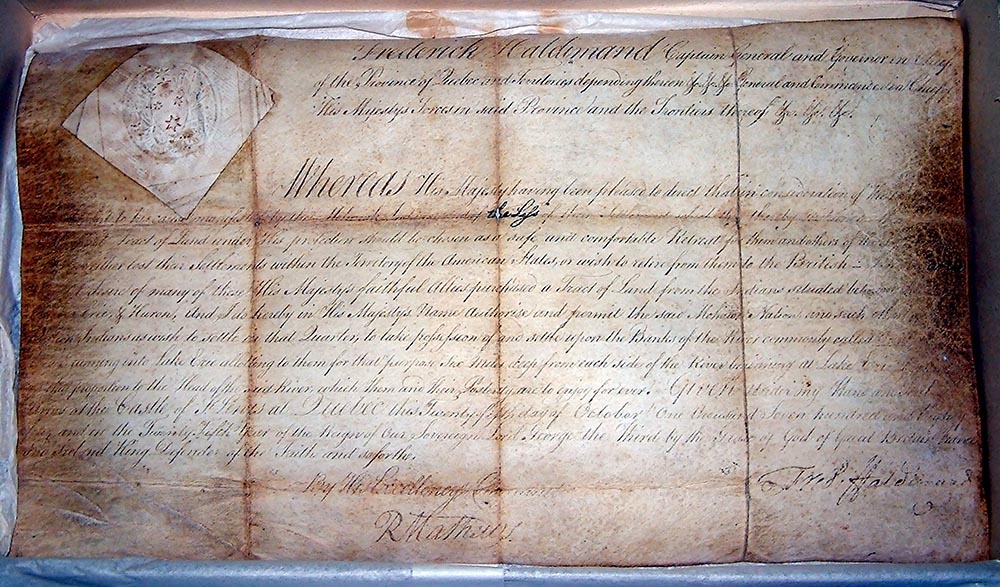
You argue that the alleged conduct took place on lands covered by the Haldimand Proclamation (1784) and related Crown instruments (Haldimand Pledge, Dorchester’s Mark of Honour, Simcoe Proclamation, 1791 confirmation).
-
You assert that these instruments create a Crown-recognized refuge and hereditary framework for the Mohawk Nation and Loyalist posterity, which Canada has never lawfully extinguished or replaced.
-
You argue that the Ontario Court of Justice, the Province, and its municipal arms are operating ultra vires (outside their lawful authority) when they treat Haldimand lands as ordinary provincial territory for criminal, taxation, and regulatory purposes.
As of now, there is no final judgment on the constitutional questions; the case is in progress and functions as a live test of your Haldimand framework in a trial-court setting.
-
Historical & Legal Context
This case sits at the intersection of:
-
The Haldimand Pledge (1779) and Haldimand Proclamation (1784), which purchased and set apart Grand River lands “for the Mohawk Nation and such others… to enjoy forever.”
-
Dorchester’s Mark of Honour (1789) and the Simcoe Proclamation (1796), which establish a hereditary Loyalist framework (U.E. posterity “by either sex”) and a process to “ascertain upon oath” those entitled to benefits and land confirmations.
-
The 1791 constitutional confirmation of these arrangements, embedding them within the structure of what became Upper Canada / Ontario.
-
Later case law and constitutional doctrine:
-
Jackson v. Wilkes and its early reading of Haldimand through an “Aboriginal usufruct” lens.
-
Guerin, Sioui, Powley on fiduciary duty and treaty-like instruments.
-
McAteer on the nature of the Oath of Allegiance.
-
McArthur / Vaziri on mandamus.
-
Roncarelli, Oldman River, and the Manitoba Language Reference on abuse of power, constitutional supremacy, and systemic breach.
-
In that landscape, HMTK v. Doolittle is not just about one accused—it is being used to press the question: can Canada and Ontario ignore the Haldimand bundle and still claim valid jurisdiction on the Grand River?
-
Key Legal Principles / Issues Being Tested
Instead of settled “principles,” this case raises a matrix of issues:
-
Constitutional Status of Haldimand & Related Instruments
-
Are the Haldimand Proclamation, Haldimand Pledge, Dorchester’s Mark of Honour, and Simcoe Proclamation properly understood as constitutional / treaty-like instruments that still bind Canada and Ontario?
-
Does the 1791 confirmation lock these into the constitutional order in a way that later statutes cannot quietly override?
-
-
Jurisdiction on Haldimand Lands
-
Do provincial criminal / quasi-criminal laws apply as if the land were ordinary Ontario territory?
-
Or is there a jurisdictional vacuum / shared jurisdiction that must be addressed before conviction and enforcement can be legitimate?
-
-
Standing and Posterity
-
Do Mohawk Loyalist descendants—identified through matrilineal clan lines and U.E. lines—have a distinct standing category separate from “Indian Act band member” or “generic Aboriginal claimant”?
-
Does the failure to maintain registries and hereditary processes (Dorchester–Simcoe) amount to a continuing constitutional breach?
-
-
Oath of Allegiance and Oath of Office
-
When officials and newcomers swear allegiance to the King / constitutional order (per McAteer), does that oath include a duty to observe Haldimand and the Loyalist framework?
-
If so, does ignoring those instruments while exercising authority on Haldimand lands cross from civil misadministration into potential criminal negligence or breach of duty?
-
-
Taxation, Roads, and Trespass
-
Are municipal taxation and road-building a form of “taxation without lawful jurisdiction” on a Crown-recognized refuge?
-
Are roads and public infrastructure effectively trespasses or misuses of land held for Mohawk posterity?
-
-
Implications for Haldimand, Loyalist, and Mohawk Questions
If your arguments are even partly accepted, this test case could:
-
Force an Ontario court to acknowledge Haldimand as part of the operative constitutional story, not just heritage wallpaper.
-
Open the door to:
-
A reference question or higher-court review on jurisdiction across the entire Grand River tract.
-
Recognition that Mohawk Loyalist posterity have a distinct legal status and that the Crown owes them specific duties (registry, consultation, restitution).
-
Scrutiny of municipal taxation, planning, and policing practices as potentially ultra vires where they rest on ignored Crown obligations.
-
Even if the trial court resists, the case builds a written record: Haldimand is pleaded, Dorchester and Simcoe are pleaded, the oath logic is pleaded, and the pattern of Crown neglect is documented in a live criminal file.
-
Points of Interest to Mohawk of Grand River Posterity
For your community and for Six Miles Deep, this case is significant because it:
-
Moves the conversation from “Facebook argument” to “court record.”
-
Demonstrates that:
-
Mohawk Loyalist posterity are willing to test Haldimand in real proceedings, not only in academic or activist spaces.
-
There is a coherent framework tying together:
-
Matrilineal clan law,
-
Loyalist U.E. posterity,
-
Haldimand as refuge,
-
Dorchester–Simcoe as hereditary system,
-
And modern doctrines of the honour of the Crown, fiduciary duty, and constitutional supremacy.
-
-
-
Acts as a proof-of-concept:
-
Your Mandamus Application and Memorandum of Law show how to bundle the “Core Four Documents,” later case law, and modern remedies into a single litigation strategy.
-
Other Mohawk/Loyalist families can look to this as a template for asserting standing, not just making moral claims.
-
-
Unresolved Questions / Future Research Directions
Because this is ongoing, almost everything is unresolved, but key questions include:
-
Will the trial court entertain your constitutional arguments fully, or will it try to sidestep them on narrow grounds?
-
If the court asserts jurisdiction anyway, will it:
-
Provide reasoned analysis of Haldimand and Dorchester–Simcoe (Doody-style fairness), or
-
Ignore them, strengthening your broader claim of constitutional amnesia?
-
-
Could this case become the launchpad for:
-
An appeal raising Haldimand directly to higher courts?
-
A reference by Ontario or Canada to clarify the application of provincial law on the Haldimand Tract?
-
A parallel civil or public law action (mandamus, declaratory relief, constructive trust, unjust enrichment)?
-
-
How will the court treat:
-
The idea of taxation without clear jurisdiction, and
-
The argument that people who take the Oath of Allegiance or Oath of Office have a criminally relevant duty not to act in ways that breach Haldimand on this land?
-
-
Sources
-
Application for Writ of Mandamus (Benjamin Doolittle) – outlining duties, breaches, and requested remedies.
-
Memorandum of Law on the Haldimand Proclamation, Dorchester’s Mark of Honour, Simcoe Proclamation, and related case law.
-
Court filings and transcripts in His Majesty the King v. Benjamin Doolittle et al. (unreported, Ontario Court of Justice).
Leave a Reply