
Liechtenstein v. Guatemala (Nottebohm Case)

Home » Case Law » Liechtenstein v. Guatemala (Nottebohm Case)
  1. Case Title & Citation
    Nottebohm Case (Liechtenstein v. Guatemala), I.C.J. Reports 1955, p. 4.

  2. Decision Summary (Neutral Overview)
    Friedrich Nottebohm, born German, lived many years in Guatemala, and obtained Liechtenstein nationality late in life. During WWII, Guatemala treated him as an enemy alien and seized his property. Liechtenstein took Guatemala to the International Court of Justice (ICJ), seeking diplomatic protection.

The ICJ held:

  • Guatemala was not obliged to recognize Nottebohm’s Liechtenstein nationality for the purpose of diplomatic protection.

  • Effective nationality requires a “genuine connection”—habitual residence, family ties, social and economic integration.

  • Nottebohm’s deep connection was with Guatemala, not Liechtenstein.

  1. Historical & Legal Context
    The case is a cornerstone of international law on nationality and diplomatic protection. It emphasizes the reality of connection over formal paperwork.

  2. Key Legal Principles Identified in the Case

  • Nationality must reflect a real and effective link.

  • Other states are not bound to accept purely formal or opportunistic nationality in international disputes.

  1. Implications for Haldimand, Loyalist, and Mohawk Questions

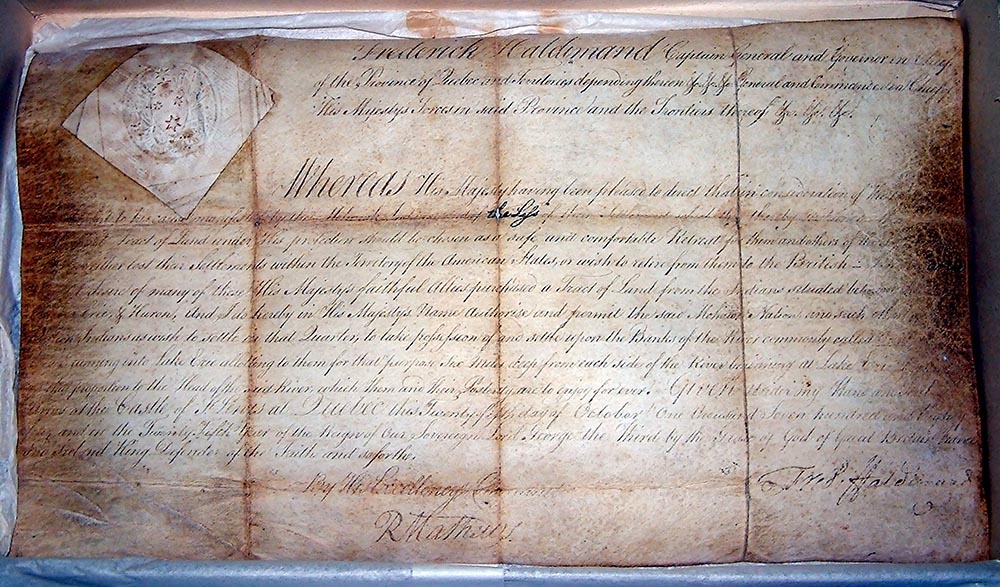
  • Nottebohm invites questions about what nationality and protection mean on extraterritorial or quasi-extraterritorial land like the Haldimand Tract.

  • If Mohawk Loyalist posterity and long-term residents have their deepest legal and historical ties to the Haldimand refuge, then purely Canadian labels may not tell the whole story about effective allegiance and protection.

  1. Points of Interest to Mohawk of Grand River Posterity

  • The case supports deeper analysis of jus soli (citizenship by birthplace) on land that was explicitly set apart as Mohawk refuge.

  • It suggests that, at least conceptually, people born and rooted on Haldimand lands could be seen as standing within a dual or layered nationality framework: Canadian in some respects, but subject to Mohawk jurisdiction in others.

  1. Unresolved Questions / Future Research Directions

  • How might a court or tribunal apply the idea of “genuine connection” in a context where territory was pledged as refuge to one nation (Mohawk) but is now administered by another (Canada)?

  • Could effective nationality language be used to argue for recognition of Mohawk nationality alongside or even ahead of imposed Canadian citizenship?

  1. Sources

  • Nottebohm Case (Liechtenstein v. Guatemala), I.C.J. Reports 1955.

  • International law commentary on nationality and diplomatic protection.

350 words

Sign up to the Newsletter!
Get the latest articles and news delivered to your mailbox.

Leave a Reply

Your email address will not be published. Required fields are marked *

Categories


About Benjamin Doolittle U.E.

listen to BLOODLINE

“Bloodline” follows the Haldimand Proclamation from its original promise to the present fight to have it honoured. The track moves through Crown grants, broken commitments, and the legal and political road back to enforcement, asking listeners to hear the Proclamation not as a relic of the past, but as a living obligation that still binds the Crown to the Mohawk Nation of Grand River.

Artist: One Way Current
Writer: Benjamin Doolittle UE
Producer: One Way Current
Publisher: Corn Press Publications
Affiliation: Six Miles Deep / Mohawk Nation of Grand River

WHITE PAPER

CROWN PLUS

Crown Plus is an initiative of the Mohawk University, dedicated to restoring truth, lawful continuity, and honour in the interpretation and application of the Haldimand Proclamation of 1784 — the foundational covenant between the Mohawk Nation and the British Crown.

This paper is divided into three parts, each exploring a distinct dimension of the Haldimand covenant: its legal origins, its modern violations, and the path toward lawful restoration. Together, they form the living record of a truth that has been long buried beneath colonial misinterpretation.Crown Plus stands for the principle that the Mohawk Nation is not a subject of the Crown, but a co-sovereign pillar upon which the Canadian state itself rests.

The phrase “Crown Plus” reclaims the language of Canada’s political history — a response to the White Paper (1969) and Red Paper (1970) — and reframes it in the Mohawk context. Where others spoke of “citizens plus,” we assert “Crown Plus”: the indivisible bond of alliance, honour, and hereditary right between the Mohawk and the Crown.

Part I — The Legal Foundations and Historical Continuity

Explores the origins of the Haldimand Proclamation, the Dorchester correction, the Mohawk–Crown alliance since Queen Anne, and the constitutional distinctiveness of the Mohawk Loyalist posterity.

Part II — Modern Violations, Fiduciary Duties, and Institutional Responsibility

Documents the breach of fiduciary duty by Crown agents, the propagation of false land acknowledgements, and the complicity of academic, corporate, and judicial institutions in sustaining unlawful occupation.

Part III — Framework for Restoration, Recommendations, and the Path Forward

Outlines a ten-year restoration plan, proposes the Mohawk Posterity Registry and Royal Commission of Continuity, and reaffirms the spiritual and legal covenant through the Crown Plus Initiative.