
-
Case Title & Citation
McAteer v. Canada (Attorney General), 2014 ONCA 578, Ontario Court of Appeal. -
Decision Summary (Neutral Overview)
McAteer and others challenged the Canadian citizenship oath, arguing that swearing allegiance to the Queen violated their freedom of expression and conscience.
The Court held:
-
The oath is allegiance to the Canadian constitutional order, not to the personal opinions or character of the monarch.
-
The Crown is a central organizing principle of the Constitution.
-
You cannot use one constitutional provision (e.g. the Charter) to erase another core feature (the Crown).
The challenge was dismissed; the oath was upheld.
-
Historical & Legal Context
Post-Charter, some litigants have argued that aspects of Canada’s monarchical framework conflict with individual rights. McAteer is a leading case articulating a holistic view of the Constitution and the symbolic role of the Crown. -
Key Legal Principles Identified in the Case
-
The oath is about structural allegiance to the constitutional order.
-
The Constitution must be read as a coherent whole.
-
One part of the Constitution cannot be used to destroy another.
-
Implications for Haldimand, Loyalist, and Mohawk Questions
-
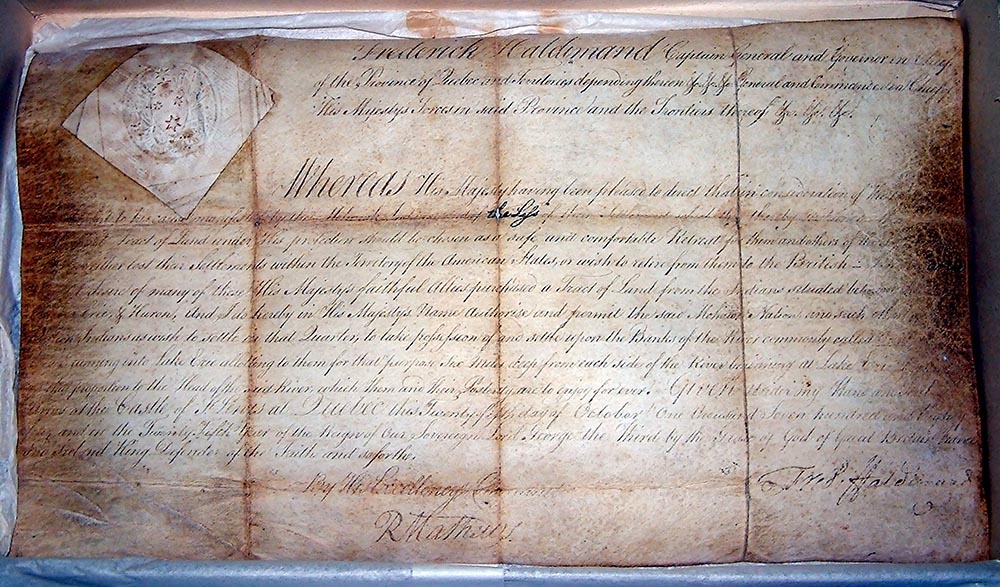
If the oath is allegiance to the constitutional order, and that order historically includes Haldimand, Dorchester, Simcoe, and the 1791 confirmation, then oath-takers have a legal duty to observe those instruments.
-
McAteer supports the argument that Canada cannot use later statutory frameworks (e.g., municipal acts, Indian Act) to erase or sideline Haldimand as a constitutional commitment.
-
Points of Interest to Mohawk of Grand River Posterity
-
The decision shows that newcomers who swear the oath implicitly accept the existing constitutional structure, including obligations toward Haldimand lands.
-
It challenges the narrative of “innocent” developers or officials who claim ignorance while acting in ways that contradict the Crown’s own written promises.
-
Unresolved Questions / Future Research Directions
-
How might a court respond if presented with evidence that the constitutional order invoked in the oath includes Haldimand and Dorchester, but governments have been behaving as if it does not?
-
Could McAteer be extended to say that oath-takers who consciously ignore Haldimand are in breach of their obligations?
-
Sources
-
McAteer v. Canada (AG), 2014 ONCA 578.
-
Citizenship Act, R.S.C. 1985, c. C-29.
-
Secondary commentary on the Crown and the constitutional order.
Leave a Reply