-
Case Title & Citation
R. v. Powley, [2003] 2 S.C.R. 207, Supreme Court of Canada. -
Decision Summary (Neutral Overview)
This case concerned whether two Métis hunters in Sault Ste. Marie, Ontario, had a constitutionally protected right to hunt moose for food without a provincial licence. They were charged under Ontario’s Game and Fish Act.
The Supreme Court of Canada ruled:
-
The Métis are a distinct Aboriginal people recognized under s. 35 of the Constitution Act, 1982.
-
A Métis community existed in the Sault Ste. Marie area with its own pre-contact continuity and practices.
-
The accused were members of that rights-bearing community.
-
Their hunting fell within a protected “Aboriginal right” as Métis.
The charges were dismissed, and the Court articulated the now-standard “Powley test” for Métis rights.
-
Historical & Legal Context
After 1982, courts had to clarify who counted as “Aboriginal peoples of Canada” and how rights would be recognized. Prior decisions focused mostly on First Nations and Inuit. Métis people had often been treated as culturally Indigenous but legally invisible.
Powley was the first major Supreme Court decision to affirm Métis rights under s. 35 and to construct a framework for identifying Métis communities and rights.
-
Key Legal Principles Identified in the Case
-
Recognition of Métis as distinct Aboriginal people under s. 35.
-
A fact-based test for identifying a rights-bearing Métis community.
-
Emphasis on historical continuity between pre-control practices and modern practices.
-
Rights are community-based, not purely individual.
-
Implications for Haldimand, Loyalist, and Mohawk Questions
-
Powley shows that courts can build a specific rights framework for a historically rooted group (Métis of Sault Ste. Marie).
-
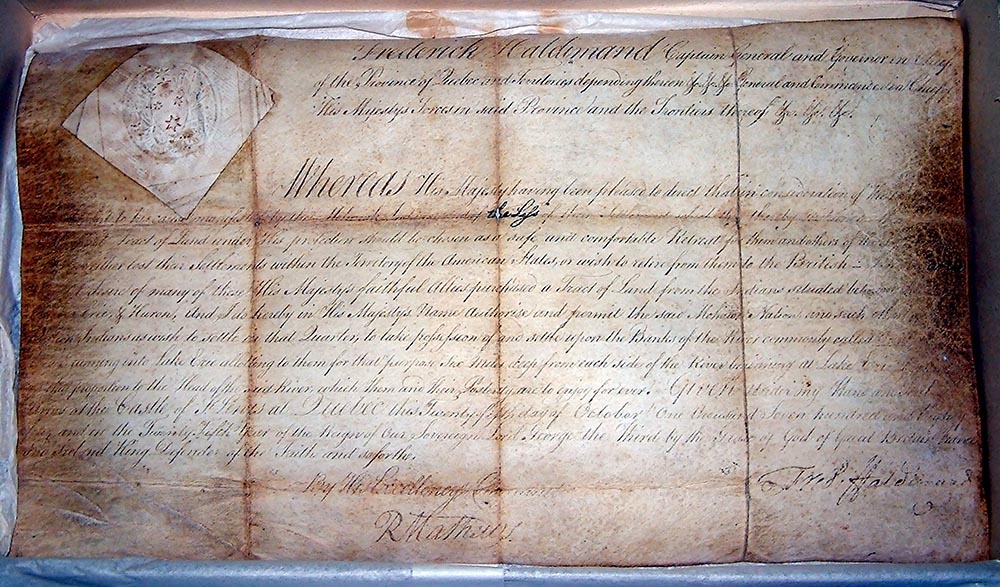
By analogy, a similarly careful framework could be crafted for Mohawk Loyalist posterity on the Haldimand Tract.
-
It supports the idea that not all Indigenous or colonially affected peoples are treated generically; law can recognize distinct communities tied to distinct instruments like Haldimand and Dorchester.
-
Points of Interest to Mohawk of Grand River Posterity
-
Powley undermines the notion that Canada must treat all Indigenous interests as one undifferentiated “Aboriginal rights” category.
-
If Métis can be recognized as a rights-bearing community with tailored tests, the same logic invites a recognition framework for:
-
Mohawk Loyalist families,
-
Tied to specific Crown promises (Haldimand, Dorchester, Simcoe),
-
On a defined territory (Grand River, six miles deep).
-
-
Unresolved Questions / Future Research Directions
-
How might a “Powley-style” test look if applied to Mohawk Loyalist posterity rather than Métis communities?
-
Could courts recognize a Haldimand-specific rights-bearing group with its own test (bloodline, Loyalist service, Mohawk national identity, etc.)?
-
How do Powley’s principles intersect with quasi-international instruments like Haldimand, rather than purely “Aboriginal rights” claims?
-
Sources
-
R. v. Powley, [2003] 2 S.C.R. 207.
-
Constitution Act, 1982, s. 35.
-
Secondary scholarship on Métis rights and the Powley test.
Leave a Reply