
R. v. Sioui

Home » Case Law » R. v. Sioui
  1. Case Title & Citation
    R. v. Sioui, [1990] 1 S.C.R. 1025.

  2. Decision Summary (Neutral Overview)
    Members of the Huron-Wendat Nation were charged with violating provincial park regulations while conducting ceremonies and cutting wood in Jacques-Cartier Park. They invoked an 18th-century agreement between British authorities and their Nation.

The Supreme Court held:

  • The agreement was a treaty within the meaning of s. 35 of the Constitution Act, 1982.

  • It protected the Huron-Wendat’s right to continue certain practices on the land.

  • Provincial regulations could not override that treaty right.

  1. Historical & Legal Context
    Sioui is a landmark in recognizing historic agreements with Indigenous nations as living treaties, even when not labelled as such by the Crown at the time.

  2. Key Legal Principles Identified in the Case

  • Broad, generous interpretation of Indigenous treaties.

  • Pre-Confederation agreements can bind provincial governments today.

  • Provincial laws of general application must give way to valid treaty rights.

  1. Implications for Haldimand, Loyalist, and Mohawk Questions

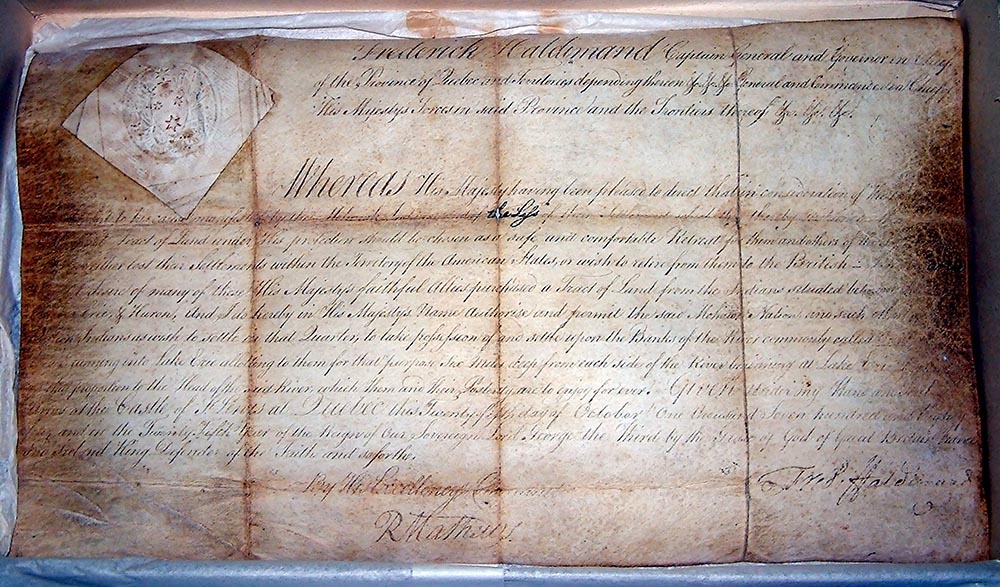
  • Sioui strongly supports viewing Haldimand, the Haldimand Pledge, Dorchester’s Mark of Honour, and Simcoe’s Proclamation as a bundle of treaty-like instruments—constitutional in nature, not mere policy.

  • It supports the argument that Ontario cannot lawfully treat Haldimand lands as simple provincial territory without addressing those instruments.

  1. Points of Interest to Mohawk of Grand River Posterity

  • Sioui shows that courts can recognize relatively obscure 18th-century documents as binding constitutional instruments.

  • It undermines any claim that Haldimand is “too old,” “too political,” or “just a letter” to have legal force.

  1. Unresolved Questions / Future Research Directions

  • How would a court handle the four-part Haldimand-Dorchester-Simcoe bundle—as one treaty, a cluster of related constitutional acts, or something sui generis?

  • Could Sioui’s generous interpretive approach be used to emphasize Mohawk Loyalist posterity as the central rights holders?

  1. Sources

  • R. v. Sioui, [1990] 1 S.C.R. 1025.

  • Scholarship on historic Indigenous treaties.

291 words

Sign up to the Newsletter!
Get the latest articles and news delivered to your mailbox.

Leave a Reply

Your email address will not be published. Required fields are marked *

Categories


About Benjamin Doolittle U.E.

listen to BLOODLINE

“Bloodline” follows the Haldimand Proclamation from its original promise to the present fight to have it honoured. The track moves through Crown grants, broken commitments, and the legal and political road back to enforcement, asking listeners to hear the Proclamation not as a relic of the past, but as a living obligation that still binds the Crown to the Mohawk Nation of Grand River.

Artist: One Way Current
Writer: Benjamin Doolittle UE
Producer: One Way Current
Publisher: Corn Press Publications
Affiliation: Six Miles Deep / Mohawk Nation of Grand River

WHITE PAPER

CROWN PLUS

Crown Plus is an initiative of the Mohawk University, dedicated to restoring truth, lawful continuity, and honour in the interpretation and application of the Haldimand Proclamation of 1784 — the foundational covenant between the Mohawk Nation and the British Crown.

This paper is divided into three parts, each exploring a distinct dimension of the Haldimand covenant: its legal origins, its modern violations, and the path toward lawful restoration. Together, they form the living record of a truth that has been long buried beneath colonial misinterpretation.Crown Plus stands for the principle that the Mohawk Nation is not a subject of the Crown, but a co-sovereign pillar upon which the Canadian state itself rests.

The phrase “Crown Plus” reclaims the language of Canada’s political history — a response to the White Paper (1969) and Red Paper (1970) — and reframes it in the Mohawk context. Where others spoke of “citizens plus,” we assert “Crown Plus”: the indivisible bond of alliance, honour, and hereditary right between the Mohawk and the Crown.

Part I — The Legal Foundations and Historical Continuity

Explores the origins of the Haldimand Proclamation, the Dorchester correction, the Mohawk–Crown alliance since Queen Anne, and the constitutional distinctiveness of the Mohawk Loyalist posterity.

Part II — Modern Violations, Fiduciary Duties, and Institutional Responsibility

Documents the breach of fiduciary duty by Crown agents, the propagation of false land acknowledgements, and the complicity of academic, corporate, and judicial institutions in sustaining unlawful occupation.

Part III — Framework for Restoration, Recommendations, and the Path Forward

Outlines a ten-year restoration plan, proposes the Mohawk Posterity Registry and Royal Commission of Continuity, and reaffirms the spiritual and legal covenant through the Crown Plus Initiative.