
|
Getting your Trinity Audio player ready…
|
The Mohawks did not receive the Grand River lands as a charitable grant, an internal allocation of Crown property, or a revocable favour. They acquired territory through alliance, military service, and political continuity during and after the American Revolution. The Crown’s role was that of a guarantor: formalizing, protecting, and constitutionally confirming Mohawk possession in a transformed geopolitical reality.
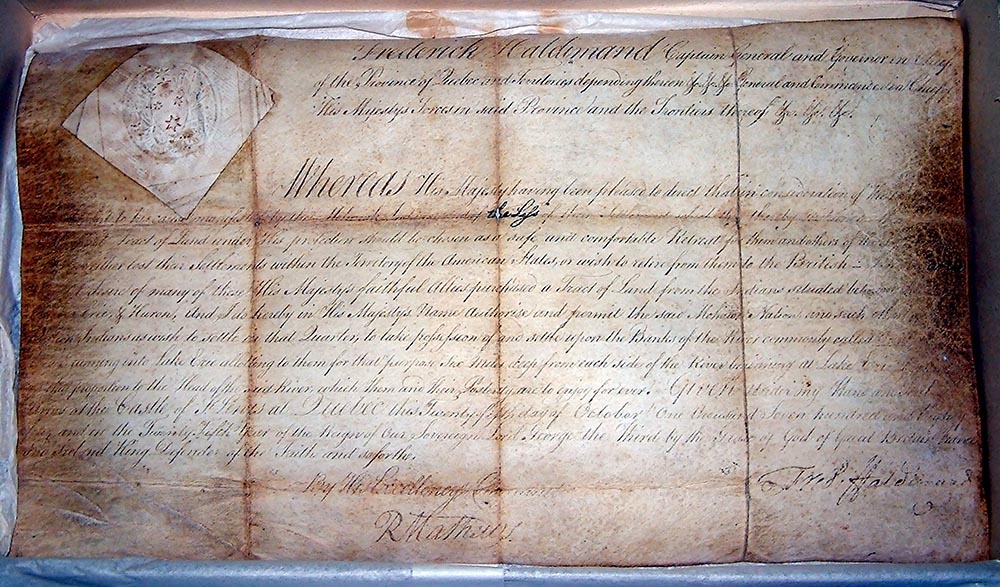
The Haldimand Proclamation of 25 October 1784 is recognition and solemn affirmation of territory already acquired—not a conveyance of Crown-owned land from first to second owner. Where an Indigenous nation acquires territory through its own actions and that acquisition is acknowledged by the Crown in clear, perpetual terms, the Crown holds burdened sovereignty: authority permanently constrained by prior Indigenous acquisition, explicit promises, and defined use. Indigenous interest comes first; Crown recognition second.
Sir Frederick Haldimand’s Proclamation states it plainly:
“…allotting to them for that purpose six miles deep from each side of the river beginning at Lake Erie and extending in that proportion to the head of the said river, which them and their posterity are to enjoy for ever.”
This is dedication language under British common law: a sovereign offer with precise boundaries (approximately 950,000 acres along the Grand River), named beneficiaries (the Mohawk Nation and allied Six Nations), an explicit purpose (a safe retreat in consideration of loyalty), perpetual duration (“for ever”), and no revocation clause.
Acceptance was unequivocal. The Mohawks relocated, settled, governed, defended, and relied upon the Tract as their own. Under common law, that reliance perfects the dedication.
Poole v. Huskinson set the foundation: dedication perfected by intention and acceptance is irrevocable at the dedicator’s whim. Canadian courts have applied this rule rigorously, even when they do not name it explicitly. Reed v. Lincoln (Town) insists on evidentiary permanence once dedication is proven. Kosicki v. Toronto (City) confirms that dedicated status does not erode by implication, administrative drift, or long misuse. Guerin v. The Queen confirms the substance: where Indigenous land interests are concerned, the Crown acts as guarantor, bound by honour and fiduciary duty.
No mechanism allows partial surrenders, non-core actions, or splinter groups to diminish the whole. The disputed instruments of the 1790s–1840s lack unanimous, informed, and uncoerced consent. No instrument of equal dignity exists.
That absence is not speculative. It was exposed directly on the floor of the British House of Commons.
On 6 March 1922, Lord Henry Cavendish-Bentinck asked the Under-Secretary of State for Foreign Affairs when, and by whom, the 1784 Haldimand instrument had been denounced—explicitly noting that its validity had been repeatedly recognised and that the Canadian government still regarded it as operative as late as 1909. Winston Churchill, replying for the government, named no act of denunciation, no statute, no treaty, and no authority terminating it. He deflected instead to the practical question of whether Six Nations people were amenable to Canadian legislation, stating that this was a matter for the Government and Parliament of Canada.
The significance of that silence cannot be overstated. In 1922—138 years after the Proclamation—no imperial authority could identify a moment of revocation. The British Parliament did not repudiate it. Canada could point to no statute expressly extinguishing it. The absence of an answer is itself proof: no denunciation occurred. Under dedication doctrine, silence in the face of a perpetual grant confirms endurance, not erosion.
This places the Grand River situation squarely within a familiar constitutional pattern: long-standing breach without lawful extinguishment.
The most powerful Canadian parallel is the Reference re Manitoba Language Rights. For ninety-five years Manitoba had systematically ignored section 23 of the Manitoba Act, 1870—a constitutional provision embedded in the bargain that brought Manitoba into Confederation—requiring all Acts of the Legislature to be enacted, printed, and published in both English and French.
Three principles from the Manitoba Language Reference apply directly to the Haldimand Proclamation:
1: Constitutional provisions using perpetual or mandatory language cannot be overridden by long-standing administrative practice or legislative silence.
Manitoba ignored its bilingual duty for 95 years; the Court refused to treat that neglect as having quietly repealed the constitution.
2: A clear breach does not extinguish the underlying right or obligation.
The statutes were invalid, but the constitutional duty remained intact and had to be fulfilled.
3: Remedies must respect both the rule of law and the original constitutional promise.
Temporary validation was a pragmatic bridge, not a licence to continue the breach indefinitely.
The Supreme Court did not hesitate. It held unanimously that the bilingual requirement was mandatory, not directory. Every statute passed in English only since 1890 was therefore of no force or effect. The Court faced the prospect of invalidating an entire provincial statute book spanning nearly a century—an outcome that would have produced immediate legal chaos: contracts unenforceable, criminal convictions unsafe, government operations paralysed, taxes uncollectible, and the rule of law itself placed in grave jeopardy.
Yet the Court refused to allow constitutional enforcement to destroy governance. Invoking the doctrine of necessity and the foundational principle of the rule of law, it declared the invalid laws temporarily valid and effective until the province could re-enact them bilingually within a reasonable time. The constitutional obligation was not extinguished by decades of breach; it was enforced, with a pragmatic transitional remedy designed to preserve continuity while compelling compliance.
Apply that exact framework to the Haldimand Proclamation. A constitutional dedication using perpetual language (“for ever”) was ignored for 240 years through disputed surrenders, taxation, regulation, and sales. The breach is larger in scale and duration than Manitoba’s. If enforced as exclusive use and enjoyment rights and recognition of acquired territory—where provincial and Canadian legislation is constitutionally prohibited from overriding the dedication, and Mohawk sovereignty and territorial autonomy are treated as binding constitutional duties—the implications would be profound but structured.
Much of the current administration of the Tract—municipal taxation premised on fee simple, provincial statutes applied without consent, and third-party titles granted without extinguishment—could be declared unauthorized or of no force or effect, just as Manitoba’s unilingual laws were. A court would likely invoke necessity and rule-of-law principles to declare existing arrangements temporarily valid during a transitional period—perhaps years or decades—to allow orderly re-enactment of jurisdiction, negotiation of restitution, accounting for lost use, and phased implementation of exclusive Mohawk governance and autonomy. Remedies would not mean sudden eviction or chaos; they would compel compliance with the original perpetual promise: Mohawk posterity’s exclusive use and enjoyment, with Crown successors constrained to honour rather than override it.
Modern law converges here. UNDRIP restates the common-law principle: lands acquired and held by Indigenous peoples cannot be unilaterally reclassified without free, prior, and informed consent. The 2025 Cowichan decision illustrates it: Cowichan Aboriginal title recognized as “senior and prior” over fee simple lands in Richmond; many Crown grants defective; infringement unjustified.
That abstract principle has already surfaced locally. In Kingspan v. City of Brantford, the court identified a latent defect in title affecting lands within the Haldimand Tract. While the decision did not resolve Mohawk jurisdiction, it confirmed that marketable title could not be assumed as unimpeachable. In response, the City of Brantford amended its planning framework to include a First Nations clause, acknowledging unresolved Indigenous interests underlying certain parcels. The clause is limited and administrative—but it is legally significant. It constitutes municipal recognition of an unresolved foundational defect, not mere political courtesy. Knowledge is established. Constructive notice is admitted.
Less than five percent of the Haldimand Tract remains under Six Nations control. Taxation and regulation proceed as if repetition could legitimize breach. It cannot.
The Six Nations of the Grand River v. Canada and Ontario litigation, with Phase 1 liability trial set for 5 October 2026, tests the core question directly: territory acquired by alliance, constitutionally recognized and set apart “for ever” in 1784, never denounced or extinguished—does it bind successors?
The law answers yes. That conclusion is reinforced by McAteer v. Canada (Attorney General). In McAteer, the Ontario Court of Appeal held that the citizenship oath to the Queen is not personal fealty to a monarch, but allegiance to Canada’s constitutional order itself—its rule of law, democratic structure, and the Crown as the legal embodiment of that order. The oath binds those who swear it to uphold the entire constitutional framework, including the honour of the Crown and binding constitutional commitments. By the same logic, successors to the Crown inherit not only authority but constraint. Administrative drift, partial instruments, or long misuse cannot override what the constitutional order preserves.
Full enforcement would therefore demand compliance with the perpetual dedication, using Manitoba-style transitional remedies to preserve order while restoring what was promised.
The Grand River Territory is no anomaly. It is an early example of a rule Canadian law is re-acknowledging: land acquired by an Indigenous nation, confirmed by solemn Crown instrument for perpetual use, remains so until extinguished by equal authority. Habit cannot substitute.
Dedicated means dedicated. Territory acquired through alliance, confirmed by the Crown, and set apart “for ever” does not quietly revert. Once recognized and perfected, the burden of sovereignty passes to every successor.
Leave a Reply