
|
Getting your Trinity Audio player ready…
|
Mandamus is a constitutional legal instrument used to compel a public authority to perform a clear and non-discretionary duty that it has neglected or refused to carry out.
It functions under the principle that where a duty exists, performance of that duty is not optional.
Mandamus arises when three legal conditions are present:
- A specific public duty exists in law.
- The duty is owed to a defined group or person.
- No other adequate remedy is available.
When issued, Mandamus does not create new rights – it enforces existing ones that have been ignored or obstructed.
The Legal Foundation: The Haldimand Proclamation
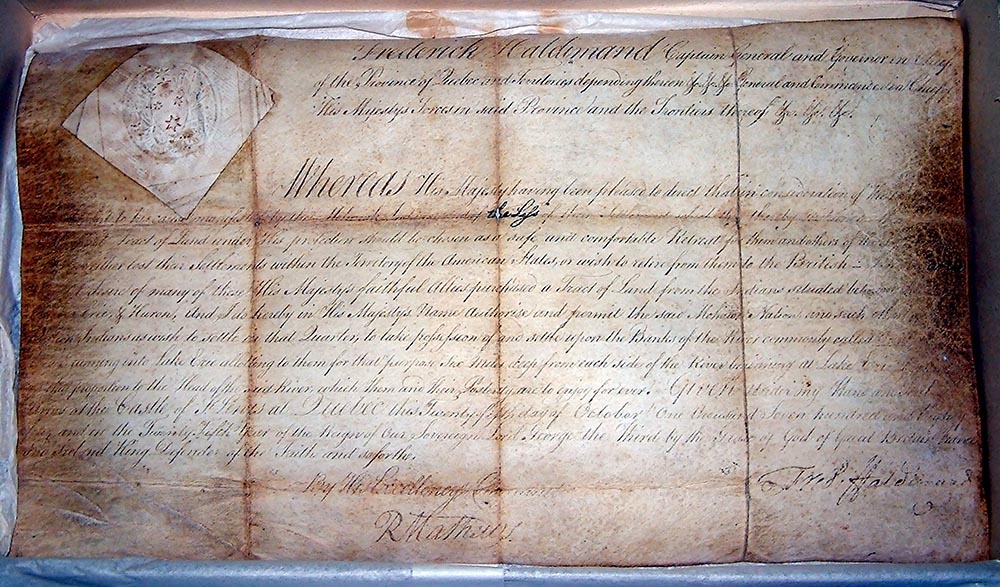
The Haldimand Proclamation, dated October 25, 1784, confirmed the grant of land along the Grand River “for the use of the Mohawk Nation and such others of the Six Nations who joined them” and specified that it was to be held “for their use and enjoyment forever.”
This language establishes a possessory interest in perpetuity.
It was not a treaty, nor a revocable license. It was a Crown act of confirmation and conveyance.
No subsequent statute, treaty, or surrender has lawfully extinguished the rights confirmed by this Proclamation.
Therefore, the legal duty to uphold and protect those rights remains active and binding on the Crown.
Nature of the Duty
The obligation created by the Proclamation is constitutional and fiduciary in nature.
The Crown must:
- Refrain from alienating or licensing the lands without lawful consent;
- Maintain the exclusive right of use and enjoyment as originally confirmed;
- Ensure that lawful beneficiaries are not displaced or deprived of that enjoyment.
Neglect of this duty, especially after notice, can constitute a breach of fiduciary duty and, under certain conditions, criminal negligence as defined by section 219 of the Criminal Code.
Standing and Hereditary Rights
The key question in enforcing this duty is who holds standing – that is, who has the recognized legal capacity to compel the Crown to perform.
Standing under the Haldimand Proclamation is hereditary, not administrative.
It arises from lineage to the three Mohawk villages named in the Haldimand Pledge of 1779, upon which the 1784 Proclamation was founded.
Those villages — the Mohawk communities who were displaced by war – formed the nucleus of the Haldimand grant.
Their descendants, and only their descendants, carry the lawful and inheritable right to assert standing in relation to the Proclamation.
This is a Crown-recognized mechanism, not an Indigenous political invention.
The Crown, in confirming hereditary rights, established that those rights pass through bloodline and not through membership in later-created administrative bodies.
Because the 1784 document named no natural person, the rights it confirmed must be connected through genealogical proof – tracing descent back to one of the original Loyalist Mohawk families of the three pledged villages.
Without that traceable link, there is no legal connection to the Haldimand covenant.
Why Band Councils and Collective Rights Groups Lack Standing
The Six Nations Elected Council and similar administrative entities were created under the Indian Act and are recognized as instruments of the Crown.
Their jurisdiction arises from statute, not from inheritance.
As such, they function as agents of the Crown, not beneficiaries of its promises.
In law, an agent of the Crown cannot simultaneously act as a claimant against the Crown.
This creates an inherent conflict of interest.
Furthermore, collective rights groups operating under the framework of the Indian Act represent a generalized population, not the specific hereditary class that the Haldimand Proclamation addresses.
Their claims therefore lack the necessary legal nexus – the direct, inheritable connection to the Proclamation’s named beneficiaries
Establishing Standing
To establish standing under the Proclamation, an individual must demonstrate:
- Lineal descent from a Loyalist Mohawk family of the three original villages;
- Continuity of identification with that lineage;
- That the right being asserted falls within the “exclusive use and enjoyment” confirmed in 1784.
This process does not require recognition by Band Council or Indian Affairs.
It is a matter of private and hereditary law, recognized under the Crown’s own legal system.
Where such standing is demonstrated, the rightful descendants have authority to seek Mandamus to compel performance of the Crown’s duties under the Proclamation.
Civil Breach and Criminal Negligence
Historically, breaches of the Haldimand Proclamation have been addressed as civil fiduciary matters.
Civil remedies, such as compensation or negotiation, have failed to resolve systemic non-performance.
However, once a fiduciary is made aware of its ongoing breach and continues to disregard its duty, the omission may rise to criminal negligence under section 219(1)(b) of the Criminal Code:
“Every one is criminally negligent who… omits to do anything that it is his duty to do, showing wanton or reckless disregard for the lives or safety of other persons.”
In the context of the Proclamation, this includes deliberate administrative neglect after formal notice – failure to act where the law clearly commands action.
Application of Mandamus
Where standing is established, Mandamus becomes the proper legal instrument to enforce Crown performance.
It can compel:
- Recognition of lawful heirs and beneficiaries;
- Protection of exclusive use and enjoyment rights;
- Correction of administrative or statutory actions that violate the Proclamation.
Mandamus restores the line of duty between the Crown and those to whom it pledged protection, performance, and honour.
Summary
- The Haldimand Proclamation creates a perpetual possessory right and corresponding Crown duty.
- That duty remains active and enforceable.
- Standing under the Proclamation is hereditary and must be proven through lineage to the three Mohawk villages of the 1779 Pledge.
- Administrative or collective entities under the Indian Act lack standing due to statutory origin and Crown agency conflict.
- Mandamus is the lawful mechanism to compel the Crown to perform its constitutional duties.
- Continued inaction after notice may constitute criminal negligence.
Conclusion
The issue is not one of political identity or collective authority.
It is a question of lawful inheritance, traceable right, and constitutional duty.
Where lineage and duty converge, standing is established.
Once standing is established, the law commands performance – and the Crown must obey.
Leave a Reply