
|
Getting your Trinity Audio player ready…
|
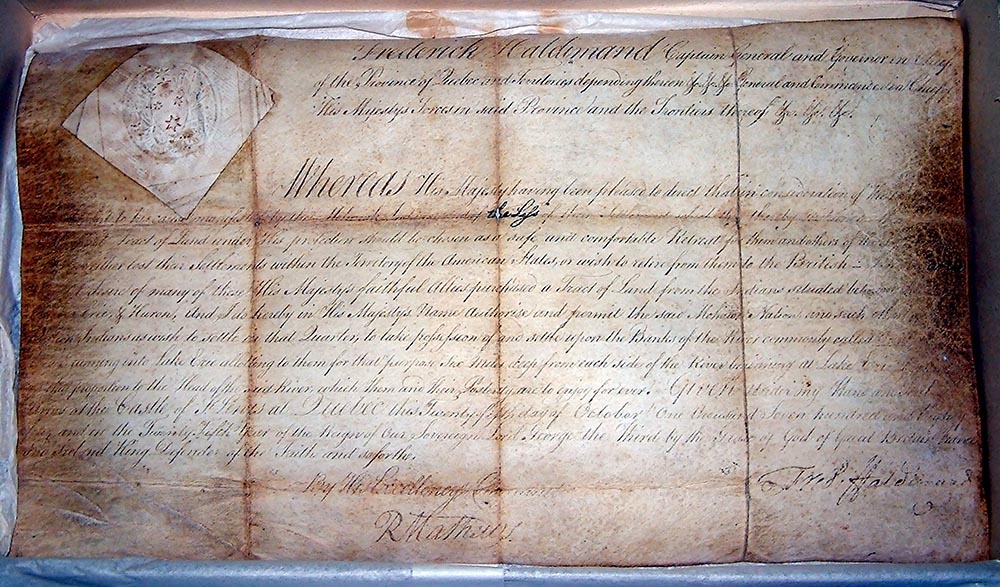
There has been increasing discussion about legal action concerning the Haldimand Proclamation of 1784 and the rights of Mohawk Loyalist posterity along the Grand River. It is important to be precise at the outset: no writ has yet been filed.
That decision is intentionaly.
What is underway is a preparatory process focused on community dialogue, transparency, and the construction of a complete public record. This work is designed to clarify duties, authority, and assumptions that have accumulated over centuries—often without serious examination—and to do so openly, before courts are asked to intervene.
Two legal instruments frame this approach: mandamus and quo warranto. These are not modern inventions. They are supervisory tools of the common law, developed for moments when government refuses to perform duties imposed by law, and when institutions exercise power without lawful warrant.
To understand why these writs are appropriate, it helps to look beyond contemporary litigation habits and return to constitutional fundamentals.
The relationship between the Mohawks and the Crown did not begin in 1784. By the early 1700s, Mohawks were recognized as military allies and diplomatic partners. During the reign of Queen Anne, Crown instructions and orders addressed the protection of Mohawk interests and the restraint of colonial overreach. That context matters because it shows a long-standing pattern: when local authorities exceeded their remit, the Crown historically had to be called back to its own obligations.
The writ of quo warranto literally asks a single question: by what authority? Historically, quo warranto was used to test whether offices, corporations, and charters were being exercised lawfully. Its modern relevance is sharpened by the Statute of Anne (1710), 9 Anne c. 25, which reformed quo warranto from a purely prerogative weapon of the Crown into a regularized legal proceeding—one capable of testing whether power claimed by an institution or officeholder rests on lawful warrant.
That reform is directly relevant to the present day. When provincial or municipal bodies assert jurisdiction on lands that were constitutionally dedicated to Mohawk posterity, quo warranto is the correct inquiry. It does not assume wrongdoing. It tests the legal foundation for the authority being claimed.
Mandamus addresses the other side of the equation. Where quo warranto tests authority, mandamus compels the performance of duties already owed. Mandamus does not create new obligations. It enforces existing ones.
The duty at issue here arises from the constitutional chain formed by the Haldimand Pledge (1779), the Haldimand Proclamation (1784), and the confirmation of that Proclamation in 1791. In our position, when Canada confirmed the Proclamation to uphold the faith of the Crown, the commitment ceased to be discretionary. It became a duty imposed by law.
Canadian courts have emphasized that constitutional obligations do not disappear through neglect. In Reference re Manitoba Language Rights, the Supreme Court of Canada addressed a sweeping failure to comply with constitutional language requirements. The Court did not treat that long-standing failure as evidence that the Constitution had become optional. The opposite occurred: the Court recognized that constitutional duties remain enforceable until fulfilled. That principle matters here because it speaks to the core problem: the passage of time does not cure a breach of constitutional obligation.
Likewise, McAteer v. Canada (Attorney General) confirms that oaths of office and allegiance are not symbolic. They are binding legal obligations. Officials who swear to uphold the Constitution undertake enforceable duties, and those duties necessarily include the obligations carried forward through Canada’s constitutional order, including pre-Confederation instruments confirmed by the Crown.
This is why mandamus and quo warranto are ideal tools for the problem at hand. Much contemporary legal discussion attempts to fold the Haldimand Proclamation into section 35 Aboriginal rights analysis. But the Haldimand instruments speak in a different legal register: allegiance, posterity, exclusivity, and perpetuity. In plain terms, the Proclamation sets out exclusive use and enjoyment for Mohawk Loyalist posterity, vested through hereditary lineage and expressed in “for ever” language. Treating that constitutional dedication as a generic Aboriginal rights claim alters the nature of the obligation and shifts the burden back onto those to whom the Crown pledged its faith.
Mandamus and quo warranto do not ask courts to invent new rights or to apply modern cultural tests. They ask courts to do what supervisory courts exist to do: enforce duties that already exist and examine whether authority is being exercised with lawful warrant.
That is the legal theory. The practical work is happening now—and it is deliberately public.
We have prepared a draft application framework and a draft Memorandum of Fact and Law (dated January 21, 2026) as an internal working instrument. It is not being presented as a filed pleading, but as a structured way to identify issues, evidence requirements, and the precise questions that community members and stakeholders should be discussing.
The draft is framed for the Superior Court of Justice (sitting in Ontario – jurisdiction contested) and contemplates paired extraordinary remedies, including an application for mandamus to compel enforcement of the Haldimand Proclamation and quo warranto to test the warrant by which asserted jurisdiction and offices are exercised on Mohawk lands.
The draft also identifies the wider set of questions that follow from those writs if the Haldimand dedication is treated seriously as a duty imposed by law. These include: the invalidity of provincial and federal legislation on Mohawk lands where it conflicts with the constitutional dedication; the need for determinations related to failures to uphold constitutional duties; the restoration of sovereignty and lands to the Mohawk Nation of Grand River; and—where unauthorized control over dedicated lands is established—the classification of errant office holders and others as trustees de son tort, triggering accounting consequences.
It also contemplates a forensic approach: a forensic audit of unjust enrichments and a structured assessment of compensation for economic, mental, and physical harms suffered over generations. These are not rhetorical “damages claims.” They are a recognition that constitutional breaches have material consequences, and that equity has mechanisms—accounting, constructive trust, fiduciary remedies—to address unauthorized control of property interests.
The key legal focus in the draft is straightforward and consistent with what we have been saying publicly: treaty obligations, oaths of office and allegiance, the exclusion of Aboriginal rights tests and collective rights frameworks where they misclassify the instrument, affirmation of exclusive use and enjoyment for Mohawk lands and posterity, and invalidity of conflicting legislation under the Haldimand Proclamation.
At the same time, we are building the record that any responsible writ process requires. Freedom of information requests and direct correspondence are being used to assemble a full inventory of communications with all stakeholders—ministries, municipalities, police services, land registry actors, and other agencies. This is not “gotcha” politics. It is institutional memory recovery. If public bodies claim jurisdiction, issue permits, levy taxes, enforce laws, or approve developments on dedicated lands, there should be documentation explaining how that authority was justified and whether the Haldimand instruments were considered. Where those records do not exist—or show that foundational instruments were ignored—that absence is itself evidence.
This is why we describe the current phase as building a clearing house. Too often, each generation is forced to re-explain the same foundational instruments because records are fragmented, assumptions go unchallenged, and institutional memory erodes. A clearing house approach preserves correspondence, decisions, and historical references in one place, cross-referenced and accessible, so dialogue can be grounded in primary sources rather than hearsay or caricature.
Support for this work does not require endorsement of a particular outcome. It requires commitment to transparency, constitutional literacy, and accountability.
We are asking community members to contribute documents and institutional memory. We are asking journalists and researchers to engage primary sources. We are asking public bodies to disclose how authority has been exercised and how constitutional obligations have been interpreted. We are asking legal scholars to examine whether the Haldimand Proclamation has been consistently misclassified and therefore consistently mishandled.
If writs are eventually filed, they will not arrive suddenly. They will follow dialogue, disclosure, and record-building—exactly as the common law intended.
Before mandamus, there must be a duty shown.
Before quo warranto, authority must be examined.
And before either, there must be a record.
That is the work underway now.
Leave a Reply