
|
Getting your Trinity Audio player ready…
|
Most Canadians have been trained to hear Indigenous land issues in one familiar language: Aboriginal rights, Aboriginal title, collective claims, duty to consult, reconciliation through negotiation. That language fits many disputes across the country, including recent litigation in British Columbia.
But it does not fit the Mohawk Loyalist position at Grand River.
This difference matters, because when the wrong language is used, the public is misled, governments apply the wrong legal tools, and a unique historical relationship is quietly erased. Treating Grand River as an ordinary Aboriginal title or Aboriginal rights issue is not just inaccurate—it is negligence.
To understand why, we need to step back and explain something clearly and simply.
Aboriginal title is a Canadian legal framework developed by courts to deal with Indigenous nations who must prove long-standing occupation of land before Canada existed. It is usually framed as a collective right shared by a community as a whole, and it requires Indigenous peoples to fit their claims into Canadian tests and balancing exercises.
The Mohawk Loyalist position at Grand River does not rely on that framework at all. Mohawks are not asking Canada to recognize Aboriginal title. They are not asking courts to apply Aboriginal tests. They are not advancing a collective rights claim under Canadian law.
Instead, they are pointing to something much more specific: a completed Crown promise, made to a named people, for a defined territory, for their posterity.
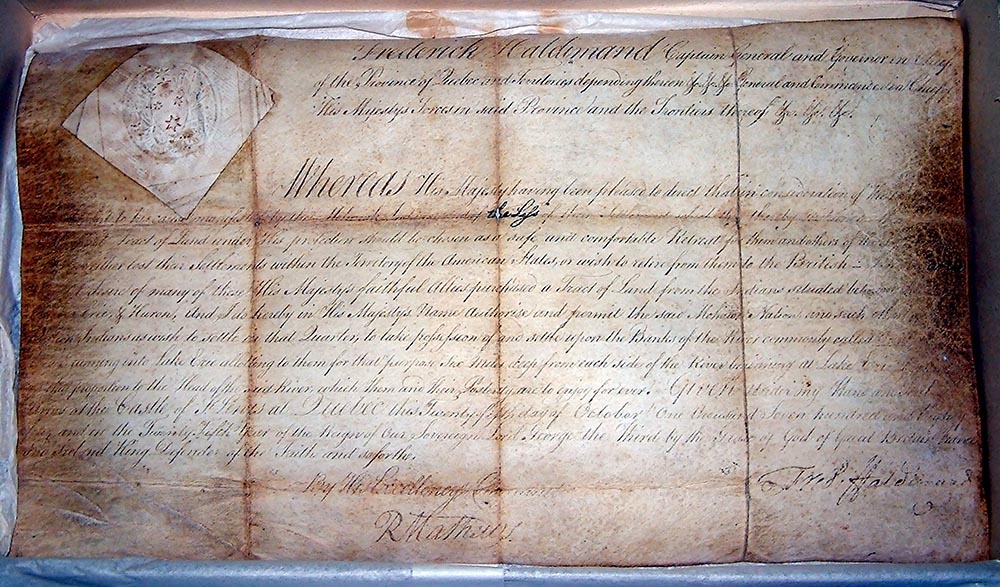
The Mohawks of the Grand River are there because of a Loyalist relationship with the Crown, not because Canada later recognized Aboriginal rights. During the American Revolutionary War, Mohawks were allies of the British Crown. That alliance resulted in displacement, not defeat. In response, the Crown made a pledge in 1779 and then fulfilled that pledge in 1784 through the Haldimand Proclamation.
That proclamation acquired and set apart a tract of land along the Grand River—six miles deep on either side—for the Mohawks of the Grand River and their posterity, with a guarantee of exclusive use and enjoyment. Those words are not symbolic. They are the substance of the promise. Under British constitutional understanding, this has been treated as a special treaty-type arrangement, not an ordinary domestic claim.
This is also why the Grand River interest is not properly treated as a collective Aboriginal rights issue. The Mohawk Loyalist position is that the Grand River settlement belongs to Mohawk Loyalist posterity: a finite, hereditary class created by the Crown’s promise. The rights flow through posterity, not through modern administrative membership. They are not based on ancient Haudenosaunee title or a pre-contact occupation test. They arise from Crown instruments directed to a Loyalist category of people, unique in its own way.
When governments or commentators treat Grand River as an Aboriginal title issue, they automatically apply the wrong machinery: consultation instead of jurisdiction, negotiation instead of compliance, policy balancing instead of honouring exclusivity. That changes outcomes. It turns a territorial obligation into a management problem and shrinks the Crown’s duties.
Much of the fear around “land back” comes from confusion between land and territory. Land is a piece of ground. Territory is land plus authority. Territory includes governance, law-making, land administration, development control, water, subsurface rights, and airspace. When the Crown promised “exclusive use and enjoyment,” it was not promising symbolic recognition. It was promising a territorial reality. The Mohawk Loyalist position is not about showing up at someone’s door to take their house. It is about restoring the integrity of a territory that was never meant to be absorbed into ordinary provincial systems.
This misclassification is not theoretical. It already has consequences.
In 2024, I raised a constitutional challenge in court to clarify the Mohawk Loyalist position at Grand River. I made a specific point: we were not relying on Aboriginal title, not relying on Aboriginal rights, and not asking the court to apply Aboriginal tests. I explained that the Grand River issue rests on Crown instruments and a Loyalist settlement for Mohawk posterity, not on collective Aboriginal rights.
Despite that, the court applied Aboriginal tests anyway.
The Justice of the Peace R. Quan folded Mohawk interests into “Six Nations” as a single historical collective, reasoning that because Mohawks have often been described as part of a larger group, the issue must be a collective Aboriginal rights matter. In doing so, the court ignored the central argument: that the Mohawk Loyalist position is based on a distinct nationality and a distinct constitutional relationship with the Crown.
This is where the harm occurs. When courts automatically assume “collective Aboriginal rights,” they remove something fundamental: the right of a people to define themselves and their legal position. In my submissions, I pointed the court to the Universal Declaration of Human Rights, which recognizes that everyone has the right to a nationality and the right not to be arbitrarily deprived of that nationality.
By collapsing Mohawk Loyalist interests into a generalized Six Nations collective—against our stated position—the court risks doing exactly that: stripping away distinct nationality and replacing it with an administrative category that fits more comfortably within Canada’s Aboriginal law framework.
That misclassification had another concrete effect.
In the same proceeding, I was not asking the court to rule on Aboriginal title at all. I was asking for something narrower and clearer: a declaration that the Mohawk Loyalists of the Grand River hold exclusive use and enjoyment over the territory, as set out in the Crown’s own instruments.
The request was straightforward. It did not ask the court to resolve every downstream issue. It did not ask the court to displace anyone. It asked the court to acknowledge, in declaratory form, what the Crown itself promised: exclusive use and enjoyment for Mohawk Loyalist posterity.
The Justice of the Peace declined to provide that declaration. The reason given was procedural. The court stated that Six Nations litigation had already sought a declaration relating to exclusive use and enjoyment, and that because a similar question was “already before the courts,” it would not issue a separate declaration in my case.
This is where the problem deepened. The declaration sought in Six Nations litigation is not the same declaration I was asking for. Six Nations litigation advances a collective claim through Indian Act structures, on behalf of Six Nations as a whole. My request was specific to Mohawk Loyalist posterity, grounded in Crown instruments, and deliberately outside the Aboriginal title and collective rights framework.
By treating these as interchangeable, the court effectively allowed one legal framing to block another—despite the fact that the parties, the legal basis, and the category of rights were different. The result was that the Mohawk Loyalist request for a declaration of exclusive use and enjoyment was stalled, not because it lacked merit, but because it was folded into a legal process that does not actually represent it.
Why does any of this matter in real life? Because, in the Mohawk Loyalist view, Canada did not “sort of” promise something. Canada confirmed the Haldimand Proclamation to uphold the honour of the Crown, and the promise was made to a specific people: the Mohawks of the Grand River and their posterity. It did not name “Six Nations” as a single collective beneficiary, and it did not convert Mohawk Loyalist posterity into a general Aboriginal category. In our position, that specificity is not historical trivia. It is the legal point.
That is why mislabeling Mohawk Loyalist interests as “Six Nations” interests is not just an academic mistake. When government actors treat a specific Crown obligation as if it were a general collective claim, they avoid making the kinds of decisions that should follow from the promise—orders, policies, and administrative actions that actually respect exclusive use and enjoyment in practice.
There is also an accountability dimension that Canadians should understand. Public officials take oaths—oaths of office and oaths of allegiance—and those oaths are not supposed to be decorative. They exist to bind decision-makers to constitutional duties, including duties tied to the Crown’s promises. If officials can ignore those duties without consequence, the honour of the Crown becomes a slogan rather than a rule of conduct.
In Canadian law, there is a serious concept behind this: when someone who holds public responsibility fails to observe a duty imposed by law, and that failure foreseeably causes harm, the law treats that failure as more than a paperwork error. I am not accusing any individual of a crime in an opinion piece. I am making a simpler point: if the Crown’s promise is treated as optional, and people are harmed by that disregard, then Canada does not just have a political problem. It has a rule-of-law problem.
That is why I pursued a declaration of exclusive use and enjoyment. It was not about creating conflict with neighbours. It was about installing a clear accountability line for the “faceless government” that acts in the Crown’s name: if you swear allegiance, then you must govern as if the Crown’s promises are real. And if the Haldimand Proclamation guarantees exclusive use and enjoyment to Mohawk Loyalist posterity, then public decision-making must stop operating as if that guarantee belongs to someone else—or to no one at all.
This is another reason Six Nations litigation does not represent the Mohawk Nation of Grand River. The long-running Six Naions litigation is often treated as if it speaks for everyone along the Grand River. From a Mohawk Loyalist perspective, that assumption is incorrect. Six Nations litigation operates through Indian Act structures. The Mohawk Nation of Grand River is not an Indian Act creation, and Mohawk Loyalist posterity is not defined by Indian Act membership. These are different legal categories. Allowing Six Nations litigation to stand in for the Mohawk Loyalist position collapses a specific territorial promise into a general collective claim. That may be convenient for governments, but it misrepresents the nature of the settlement and risks permanently misframing the rights involved.
The Indian Act is a Canadian statute. Band councils are administrative bodies created under that statute. They do not rewrite earlier Crown instruments, and they do not redefine who “posterity” is for the purpose of a Loyalist settlement. Mohawk Loyalist posterity includes descendants who may not be eligible for Indian Act registration at all. Over generations, descendants may hold many nationalities—Canadian, British, Zambian, or others—because posterity is about lineage, not paperwork. A Crown promise to posterity does not disappear because someone cannot or does not register under the Indian Act. That is another reason this settlement sits outside the Aboriginal collective rights system Canada built later.
Canada inherited a Loyalist settlement it never properly completed. Instead of honouring exclusive use and enjoyment, it layered provincial systems on top and treated the territory as ordinary land. Over time, the original promise was managed away rather than fulfilled. Calling this an Aboriginal title issue makes that easier, but it also makes it wrong.
Cowichan and Grand River are not the same. One fits modern Aboriginal title law. The other is a special Loyalist settlement grounded in Crown instruments, directed to Mohawk posterity, and carrying territorial consequences Canada has postponed for generations. If reconciliation is to mean anything real, it must start with using the right language—and acknowledging the right obligations.
Accuracy is not confrontation. It is the beginning of honour.
Terms used in this entry
- Lexicon: Mohawk Loyalist Posterity
- Encyclopedia: Haldimand Proclamation of 1784
- Lexicon: Six Miles Deep (Concept)
- Lexicon: Exclusive Use and Enjoyment
- Lexicon: Indian Act
- Lexicon: Honour of the Crown
- Lexicon: Mohawk Nation of Grand River
Where these terms are used in posts and pages
- Mohawk Loyalist Posterity: WAKONRORI — “I TOLD YOU SO”: Bridges, Boldness, and the Unfinished Question Beneath the Grand River
- Haldimand Proclamation of 1784: BEFORE THE WRITS: Building a Public Record for Mandamus and Quo Warranto on the Haldimand Proclamation
- Exclusive Use and Enjoyment: WAKONRORI — “I TOLD YOU SO”: Bridges, Boldness, and the Unfinished Question Beneath the Grand River
- Indian Act: WAKONRORI — “I TOLD YOU SO”: Bridges, Boldness, and the Unfinished Question Beneath the Grand River
- Honour of the Crown: ACQUISITION FIRST, DEDICATION CONFIRMED: The True Legal Story of an Acquired Territory
- Mohawk Nation of Grand River: WAKONRORI — “I TOLD YOU SO”: Bridges, Boldness, and the Unfinished Question Beneath the Grand River
Leave a Reply