
|
Getting your Trinity Audio player ready…
|
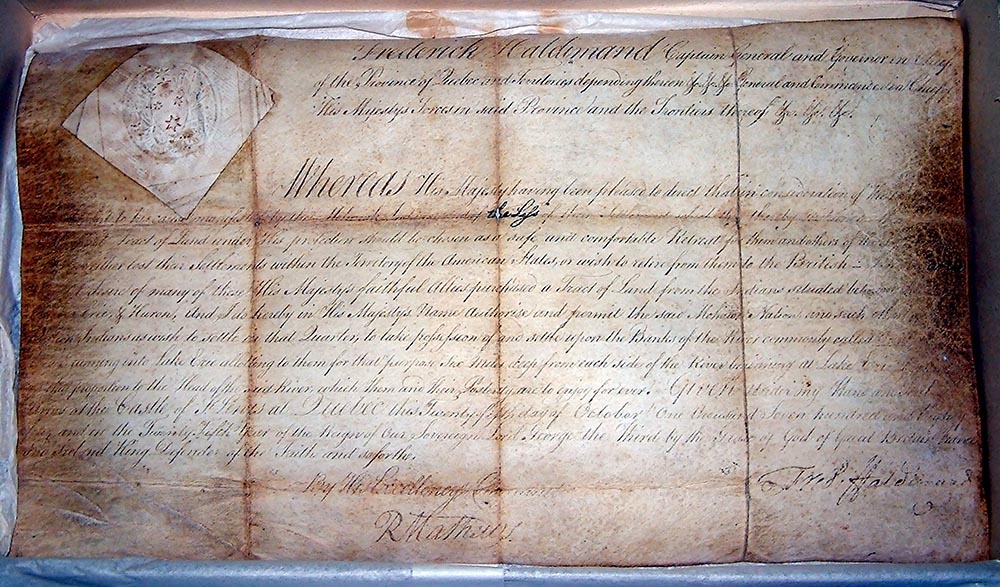
The Grand River Territory was not a charitable land grant. It was acquired territory—acknowledged and set apart in 1784 for the “exclusive use and enjoyment” of the Mohawks and their posterity following alliance, military service, and displacement during the American Revolution. That distinction is foundational. The corridor was not a discretionary administrative reserve carved out of undisputed Crown domain. It was territory recognized by the Crown after Mohawk acquisition and political continuity in a transformed geopolitical landscape.
If that dedication imposed a constitutional condition upon sovereignty, then everything layered onto the six-mile corridor since 1784—provincial statutes, municipal taxation regimes, infrastructure authorities, licensing systems—must operate subject to that burden. The question is not whether governments have acted as though the corridor were unburdened. The question is whether they were ever entitled to.
That distinction—between land and territory—is critical.
Under Canadian statutory frameworks, “lands” often refer to parcels administered under federal legislation such as the Indian Act. These lands exist within a system of delegated oversight. Title may be described as held “for the benefit” of a band, but alienation powers, taxation authority, and expropriation frameworks remain circumscribed. This is not territorial sovereignty in the international sense. It is statutory administration within a federal system.
“Territory,” by contrast, reflects inherent jurisdiction. For the Haudenosaunee Confederacy, territory is bound to law, kinship, diplomacy, and economic networks that predate Confederation. It encompasses not only surface occupation but underlying interests: waters, minerals, timber, transit routes, and the economic potential flowing from them. These interests do not evaporate because fee-simple title has been registered in a provincial land registry. Canadian jurisprudence recognizes that Indigenous interests can persist beneath asserted Crown sovereignty. Registration is not constitutional extinguishment.
When discourse narrows to “Land Back,” it frames the issue as parcel transfer. “Territory Back” restores the proper scale: jurisdictional authority across the original corridor, including regulatory, fiscal, and economic control consistent with constitutional commitment.
Internationally, acquired territory refers to land obtained through recognized means—cession, treaty, recognized occupation, or acknowledged transfer of sovereignty. Once acknowledged, such territory is not treated as provisional occupancy but as juridical entitlement. The United Nations Declaration on the Rights of Indigenous Peoples affirms that Indigenous peoples have rights to the lands, territories, and resources which they have traditionally owned, occupied, or otherwise acquired, and that states shall give legal recognition and protection to these territories consistent with Indigenous customs and tenure systems.
The Grand River corridor fits that language. It was not assigned as a favour; it was acknowledged and set apart as territory acquired and to be enjoyed exclusively by Mohawk posterity. If that acknowledgment is constitutional in character, then under both domestic hierarchy and international standards, it carries binding force.
Modern governance within the six-mile boundary proceeds as though the corridor were ordinary provincial land. The Municipal Act, 2001 empowers municipal councils to levy property taxes, enact bylaws, and regulate local matters. The Planning Act authorizes rezoning, subdivisions, and development approvals that transform farmland into residential and industrial estates. The Assessment Act supplies the valuation mechanism that underpins municipal taxation. The Electricity Act, 1998 structures transmission corridors and provincial grid control. The Conservation Authorities Act governs watershed regulation along the Grand River. Federally, the Telecommunications Act and the Radiocommunication Act establish national control over telecom networks and spectrum licensing. The Canada Transportation Act structures national transportation undertakings intersecting the corridor.
Each statute asserts authority. Each presumes that Ontario and Canada possess unburdened sovereignty within the corridor. None explicitly administers its powers subject to the prior dedication for exclusive use and enjoyment.
Ontario has argued in various contexts that it established itself on the land irrespective of the Haldimand commitment, partly because the dedication is not categorized as a modern Section 35 treaty. But constitutional character does not depend on administrative classification. A Crown assurance that burdens sovereignty does not dissolve because later statutes omit reference to it. If the dedication formed part of the constitutional architecture inherited at Confederation, then provincial sovereignty was inherited subject to that condition.
The Manitoba Language Rights Reference clarifies how hierarchy operates. The Supreme Court of Canada held that statutes enacted contrary to constitutional requirements were invalid, even after decades of operation. Constitutional supremacy is not defeated by administrative practice. Legislation inconsistent with higher law is of no force or effect, though courts may preserve continuity temporarily to prevent chaos.
The absence of a criminal penalty for violating the Haldimand dedication does not diminish its potential constitutional force. Constitutional obligations are often structural rather than penal. They bind through hierarchy, not punishment.
If the Grand River dedication imposed a constitutional condition, then public officers—municipal councillors, provincial ministers, federal regulators—are under a duty imposed by law to administer their powers consistently with that condition. The remedy for breach is not prosecution; it is declaration. If necessary, mandamus compels observance of the duty.
Authority flows downward through offices; responsibility flows upward. Municipal councils exercise delegated provincial power under the Municipal Act and Planning Act. They cannot exercise more sovereignty than the province holds. If the province’s sovereignty in the corridor is burdened, municipal authority is doubly constrained.
Provincial ministers—Municipal Affairs, Energy, Environment—administer statutes that structure land use and infrastructure. Their portfolios derive authority from legislation enacted by the Legislative Assembly and assented to by the Lieutenant Governor in the name of the Crown. If the Crown pledged exclusive use and enjoyment of the corridor, those ministers must administer their portfolios subject to that pledge.
The Lieutenant Governor, as the Crown’s representative in right of Ontario, embodies provincial sovereignty. Orders in Council, regulations, and Royal Assent flow through that office. If the Crown’s honour was pledged to Mohawk posterity in relation to the Grand River corridor, the representative of that Crown cannot treat the pledge as symbolic.
At the federal level, Parliament and responsible ministers exercise authority over telecommunications, spectrum, and transportation. Those powers are exercised in the name of the Crown in right of Canada. If the dedication binds sovereignty itself, federal action within the corridor must align with it.
Telecommunications makes the constitutional collision especially visible. Canada treats telecom not as mere commerce but as a core sovereign function. The Telecommunications Act structures national connectivity. The Radiocommunication Act vests spectrum licensing and control in federal authority. Connectivity supports defence, commerce, emergency services, and governance. Telecom is a prong of sovereignty.
Yet telecom infrastructure in the Grand River corridor occupies territory pledged for exclusive use and enjoyment. Historically, the irony is profound. Alexander Graham Bell’s early work in the Brantford region unfolded alongside Mohawk communities. Bell studied the Mohawk language and later received honorary recognition within the community. Early telephone demonstrations included Mohawk words spoken into the transmitter. The corridor’s telecom history is intertwined with Mohawk presence.
Today, spectrum is monetized nationally through geography physically situated on pledged territory. Towers are sited. Fiber is laid. Subscription revenue flows from households within the six-mile boundary. If telecom is sovereign authority exercised through land, then it is sovereign authority exercised through land constitutionally burdened by prior dedication.
Sovereignty cannot expand in one direction while pretending that earlier constitutional commitments never existed. Telecom may continue—but as burdened sovereignty, administered subject to the exclusive-use condition.
The economic stakes are substantial. Residential and commercial development across the corridor represent asset values in the billions. Beneath each home lie pipes, fiber cables, hydro lines, and roadway infrastructure created through planning approvals. Aggregate extraction removes subsurface resources under provincial licence. Agricultural production generates export value. Insurance markets collect premiums tied to property and vehicles operating within the corridor.
Yet Mohawk institutions outside federal statutory frameworks have no independent revenue base proportionate to this wealth. There are no corridor-funded Mohawk education endowments. No healthcare systems capitalized by land-based revenue. No elder-care trust sustained by infrastructure participation. No territorial insurance architecture capturing risk borne by pledged land.
Vehicles traverse the territory daily, insured under provincial systems. Aircraft pass overhead. Pipelines and transmission corridors create environmental exposure. Risk is monetized elsewhere. The land bears exposure; the beneficiary class receives no structural return.
The objective is not chaos or confrontation. It is recognition. If municipal councils, provincial ministers, the Lieutenant Governor, and federal authorities acknowledge that the Grand River corridor is acquired territory burdened by constitutional dedication and affirmed by international standards such as UNDRIP, they can realign administration voluntarily. Taxation regimes can be adjusted. Infrastructure compacts can be negotiated. Telecom and transmission can be administered in partnership rather than unilateral presumption.
If they do not, courts may be asked to declare what constitutional hierarchy already implies: that the Crown and its officers are under a duty imposed by law to observe the exclusive use and enjoyment condition of the Grand River Territory.
The Grand River corridor is not merely a municipal footprint. It is pledged territory. Acquired territory. Territory embedded in constitutional order. If that condition is recognized, sovereignty within the six-mile boundary will be administered as it always should have been: not as absolute dominion, but as authority exercised within the limits of a prior pledge.
Leave a Reply