
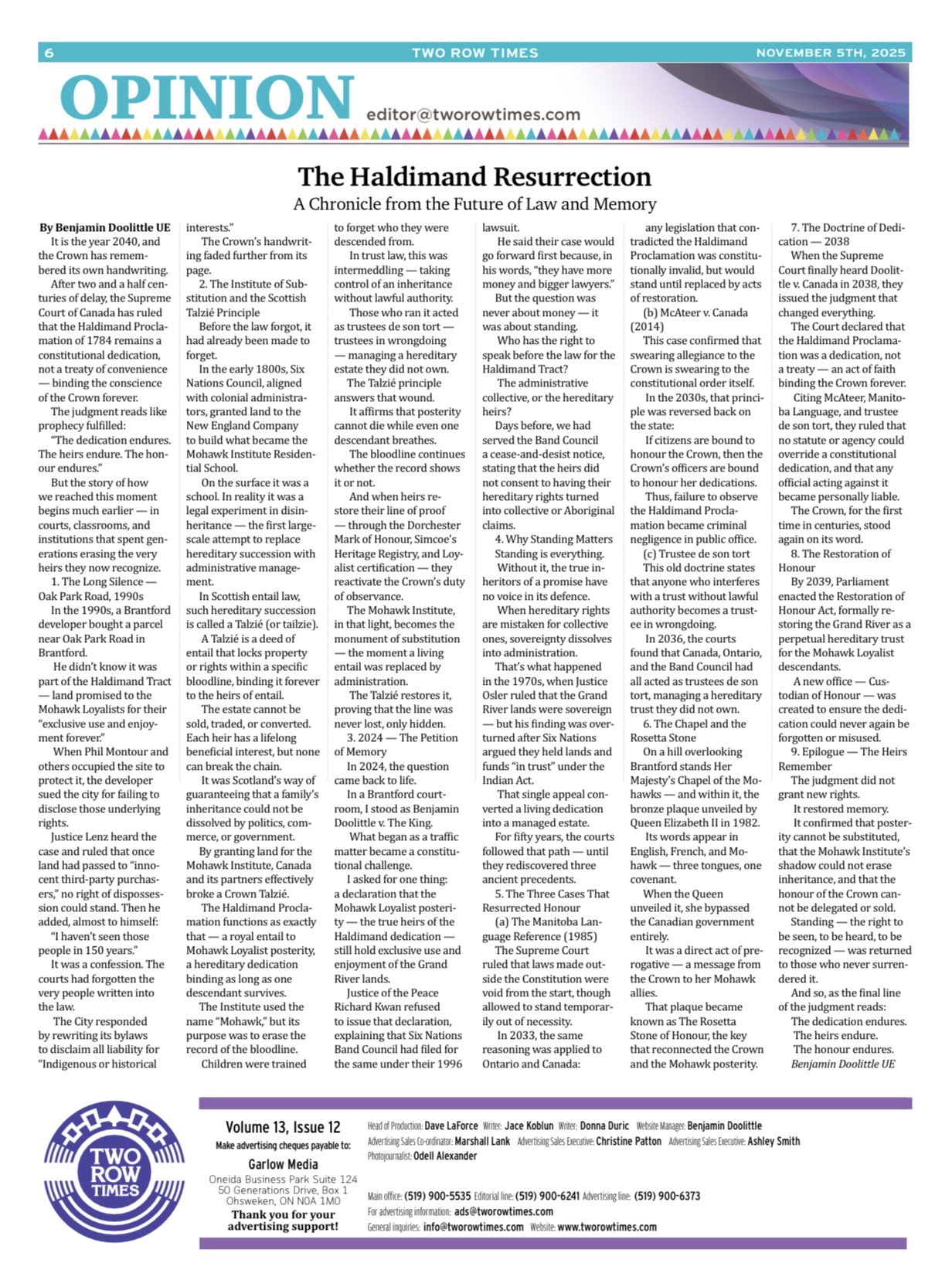
|
Getting your Trinity Audio player ready…
|
The modern story of the Haldimand Tract rests on a misunderstanding large enough to reshape an entire region’s legal and political identity, even citizenships. Most people today believe the land was granted to “the Six Nations” collectively. Universities repeat it, municipalities recite it, courts assume it, and institutions build policies around it. But the Haldimand Proclamation itself, the British legal traditions that shaped it, and the historical record surrounding its issuance all say something entirely different. The grant was hereditary, not collective. It was issued to the Mohawk Nation as the primary beneficiary, with “such others of the Five Nations” allowed to settle with them, but not to replace them. That distinction is not symbolic. It defines who holds the legal right to the land today.
To understand the grant, it must be seen as the closing of an earlier promise. In 1779, Governor Frederick Haldimand pledged to secure land for the Mohawks should they be forced from their homelands for remaining loyal to the Crown. That pledge was broad, but the 1784 Proclamation refined and executed it. It identified the actual people who suffered the loss: the Mohawk families from the three principal Mohawk villages destroyed during the war—Tiononderoge, Canajoharie, and the Lower Castle. These villages provided the core of the Loyalist Mohawk population resettled at the Grand River. This refinement matters because it shows that the Crown intended to remedy the dispossession of identifiable Mohawk communities, not a generalized political collective. Their descendants can still be traced today, which means hereditary rights remain legally alive.
The Proclamation’s wording matches 18th-century British entailed grants. It grants land “to the Mohawk Nation and such others of the Five Nations as wish to settle in that quarter, to be held by them and their posterity to enjoy forever.” In British law, the first named—the institute—is the primary hereditary heir, and the “others” are substitutes who may benefit but cannot supersede the institute’s line. This legal structure was clarified in cases like Wilkes v. Jackson (1779), where the House of Lords held that “A and such others” does not create a collective legal body, only individual beneficiaries; and in Kirk v. Morris (1866), where “such other person” was defined as someone not originally part of the transaction who cannot replace the original heir. Under Scotch tailzie law, described by Erskine, substitutes cannot displace the institute unless the line ends. Nothing in British law allows the “others” to become the primary heirs.
A hereditary grant means rights flow by posterity, not by Indian Act membership or political constructs created later. Mohawk posterity includes descendants of Loyalist Mohawk families recorded in the 1784–1785 settlement lists, through either maternal or paternal descent. These rights persist unless extinguished by treaty or statute, and no such extinguishment occurred. This is why genealogical tracing matters: if sovereignty or land rights can be diminished by misidentifying the rightful heirs, the entire nation should not bear the loss. Only those tied to the original hereditary interest can be implicated. Misclassifying the grant as belonging to a broad collective exposes thousands of people to a sovereignty argument unrelated to them, while stripping the rightful heirs of their legal standing.
The widespread belief that “Six Nations” inherited the Haldimand Tract comes from a modern administrative assumption, not historical fact. The Haudenosaunee Confederacy existed, but “Six Nations of the Grand River” is a post-Confederation administrative creation, formalized under the Indian Act and reinforced when the RCMP imposed the Band Council in 1924, removing hereditary councils and the genealogical frameworks that preserved the original institute. The Proclamation never used the term “Six Nations.” British records always distinguished Mohawks from the other nations. Treating “Six Nations” as the inheriting entity must cease, because it was never the beneficiary and its continued use places sovereignty and inheritance at risk.
The wrong narrative spread because Canada preferred dealing with a single administrative entity; the Mohawk Institute disrupted genealogies; the 1924 Band Council replaced hereditary leadership; and beginning in 1995, the Six Nations Lands & Resources “Global Solutions” booklet rewrote the text of the Proclamation by substituting “Six Nations” for “Mohawk Nation.” Municipalities, universities, museums, and even heritage organizations repeated this rewritten version. In more than 280 land acknowledgements I have examined, not one mentions the Mohawk Nation. The only accurate acknowledgement remains the federal plaque unveiled by Queen Elizabeth II in 1984 at the Mohawk Chapel, which correctly states that the land was granted to the Loyalist Mohawks.
Historical officials made similar errors. Frank Oliver, Minister of the Interior in 1909 and 1914, told the House of Commons the Grand River Indians were in a “different legal position” and had been given land “under special treaty as allies of Great Britain,” but he repeatedly misidentified them as “Six Nations Indians.” In 1922, when Lord H. Cavendish-Bentinck asked Winston Churchill when the 1784 treaty had been denounced, Churchill avoided the question, saying only that the issue of amenability to Canadian legislation was for Canada to decide, implicitly acknowledging the treaty had never been revoked. Canada relied on this ambiguity to eliminate hereditary councils in 1924. Each generation inherited the error, further burying the Mohawk institute beneath a collective identity the Proclamation never created.
The courts have repeated this misclassification. When I sought a declaration in 2024 affirming the Mohawk hereditary right and distinct Mohawk identity, I cited the Proclamation, Wilkes v. Jackson, Kirk v. Morris, the Canandaigua Treaty fraud in which Timothy Pickering admitted to including Mohawks without consent, and Article 15 of the Universal Declaration of Human Rights. The judge ruled that Mohawks were simply part of Six Nations and that it made no difference which body brought the application. The ruling mirrored the same misunderstandings that have accumulated over two centuries.
A hereditary Loyalist grant is a sui generis legal instrument. It is not an Aboriginal collective right, not an Indian Act right, and not a treaty right. It is a Crown grant rooted in inheritance. The law requires that land can only be restored to the rightful hereditary successors, and genealogical accuracy is essential. Courts cannot return land to the wrong party without exposing the Crown to further liability. Six Nations Band of Indians cannot meet the legal requirements to be the successor because it was created in 1924, does not represent posterity, includes many without Loyalist Mohawk lineage, and excludes Mohawk descendants lacking Indian Act status. Only Mohawk posterity descending from the three villages identified in the refinement of the Haldimand Pledge can lawfully inherit.
The 1995 Six Nations land claim seeks a declaration that the Band Council is the exclusive use and enjoyment rights-holder to the Haldimand Tract. If granted, this would finalize the substitution of the institute by the substitute, replacing hereditary rights with a political corporation created long after the fact. The Haldimand Proclamation has never been revoked, surrendered, or denounced. It remains a hereditary grant to the Mohawk Nation and their posterity. Whether that promise survives or is erased through misunderstanding will be decided in 2026. The question now is whether the courts will finally recognize the rightful heirs or continue the pattern of misclassification that has, so far, denied the Mohawk people the inheritance and enjoyment pledged to them “forever.”
Terms used in this entry
- Lexicon: Haldimand Tract
- Encyclopedia: Haldimand Proclamation of 1784
- Lexicon: Mohawk Loyalist Posterity
- Case Law: Doe ex dem. Jackson v. Wilkes (1835)
- Case Law: Kirk v. Morris
- Lexicon: Indian Act
- Lexicon: Band Council
- Lexicon: Indian Act Status
- Encyclopedia: Haldimand Pledge of 1779
- Lexicon: Exclusive Use and Enjoyment
Where these terms are used in posts and pages
- Haldimand Tract: WAKONRORI — “I TOLD YOU SO”: Bridges, Boldness, and the Unfinished Question Beneath the Grand River
- Haldimand Proclamation of 1784: BEFORE THE WRITS: Building a Public Record for Mandamus and Quo Warranto on the Haldimand Proclamation
- Mohawk Loyalist Posterity: WAKONRORI — “I TOLD YOU SO”: Bridges, Boldness, and the Unfinished Question Beneath the Grand River
- Indian Act: WAKONRORI — “I TOLD YOU SO”: Bridges, Boldness, and the Unfinished Question Beneath the Grand River
- Band Council: THE MISUNDERSTOOD LEGACY: How Mohawk Wealth Built Canada — and the Ongoing Struggle for Justice in the Grand River Territory
- Indian Act Status: Lesson 2.3 – Hereditary Rights vs Administrative Categories
- Haldimand Pledge of 1779: WHAT LIES BENEATH THE GRAND RIVER: Haldimand, Riparian Law, and the Mohawk Environmental Mandate
- Exclusive Use and Enjoyment: WAKONRORI — “I TOLD YOU SO”: Bridges, Boldness, and the Unfinished Question Beneath the Grand River
Leave a Reply