
|
Getting your Trinity Audio player ready…
|
When critics ask why Canada continues to “give money” to Indigenous communities, they reveal a false premise: that restitution is charity. It is not. What is often described as “funding” is, at best, a partial and politically managed repayment of a far older debt—one created by systemic dispossession and the long diversion of revenues intended for Indigenous nations. Treaty obligations, land revenues, and resource profits were repeatedly redirected into Crown and settler systems, helping build infrastructure and institutions while the original beneficiaries were left with imposed governance, restricted access, and chronic scarcity.
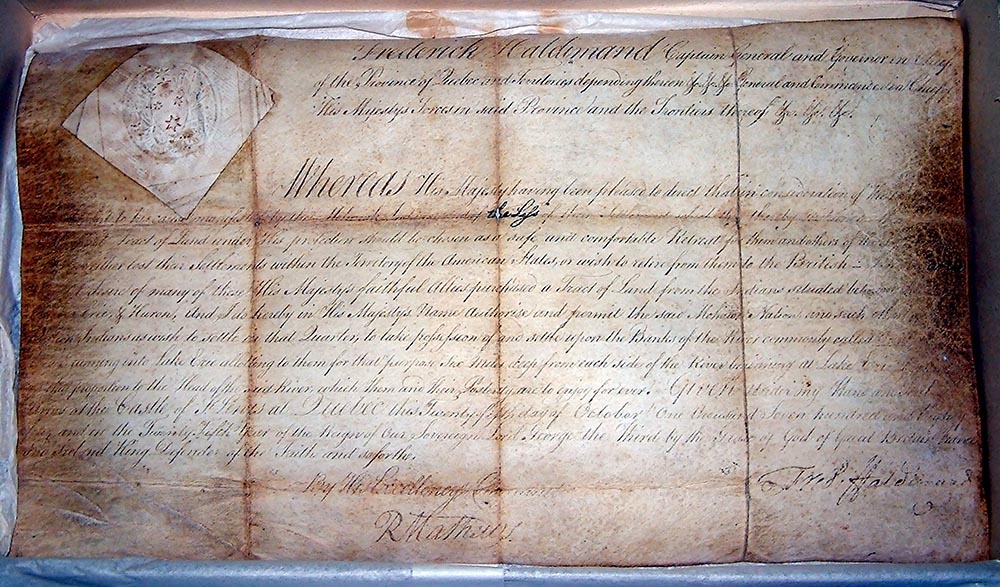
Nowhere is this clearer than in the Grand River Territory. The Mohawk Nation, loyal to the Crown during the American Revolution, was promised roughly 950,000 acres through the 1784 Haldimand Proclamation—land their posterity was to enjoy “for ever.” What followed was not stewardship. It was extraction in slow motion. Mohawk-linked wealth from timber, land revenues, leases, and development pathways was steadily absorbed into Canadian growth, while Mohawk posterity was pushed to the margins of the very territory that generated that wealth.
The Haldimand Proclamation was not a domestic policy. It was a treaty-level covenant rooted in alliance under the Covenant Chain. It recognized the Mohawks as sovereign allies, not Crown subjects. That alliance reaches back at least to 1710, when Mohawk diplomats—known historically as the “Four Indian Kings”—met Queen Anne in London, renewing relationship and military purpose, with diplomatic gifts that still exist today. The Haldimand grant must be understood in that frame: a territorial settlement tied to alliance, continuity, and status quo ante bellum—the principle that what was held before a conflict remains held after, unless lawfully altered.
Equally important is what the Haldimand Tract was not. It was not reserve land created under later administrative regimes. It was not land “held in trust” under Canadian statute. It was land set apart before Confederation. When Canada formed in 1867, it inherited pre-existing Crown obligations, including proclamation-level commitments and the constitutional duties that accompany them. Early confirmations and boundary work reinforced the grant’s operative reality through surveys and colonial administration, creating a clear duty to observe the Proclamation’s terms. Those duties are echoed in the oaths taken by public officials, judges, and office holders who swear to uphold the Constitution and the lawful obligations embedded within Canada’s founding architecture.
From the beginning, however, Canada’s institutional behaviour worked to convert an alliance-based territorial promise into something manageable, taxable, and alienable. The Grand River Territory was rich: timber, minerals, fertile land, and river corridors capable of anchoring trade and settlement. Rather than ensuring that this wealth strengthened Mohawk posterity, the Crown and its agents repeatedly facilitated non-Indigenous settlement and then treated the resulting conflicts as problems to be solved at Indigenous expense.
In the early nineteenth century, squatters poured into Brantford-area lands. Instead of enforcing removals that would have protected the original grant, governments shifted toward accommodation. In at least one notorious episode, squatters were paid significant sums to vacate—money drawn from Indigenous funds—meaning the original holders effectively financed the exit of intruders while receiving no restoration of benefit. In the 1830s, an 807-acre “white man’s reserve” in Brantford was treated as though it could be surrendered, despite the deeper flaw: no lawful mechanism existed to alienate Haldimand land in the way later administrators presumed it could be alienated.
Financial extraction did not stop at land. Mohawk-linked revenues were drawn into projects that benefited the colonial economy first. Funds were tied up in ventures such as the Grand River Navigation works, later sold off for fractions of their value; proceeds were routed into institutions that became pillars of Canadian professional and educational life; and even coercive systems like the Mohawk Institute residential school were enabled through pressured land transactions tied to missionary and corporate entities. The pattern is consistent: Indigenous capital and land underwrote settler development, while Indigenous communities were denied control and the compounding benefits of ownership.
Historical reporting and commissions from the mid-nineteenth century preserve the texture of this period: growing settler encirclement, disruption of traditional economic life, and a forced pivot into systems where Indigenous advancement was measured through an imposed civilizational lens rather than recognized jurisdiction and prosperity. Oral histories and community memory describe the violence of displacement. Accounts attributed to Six Nations historian and journalist George Beaver, and commemorated in community pageantry such as The New Beginning, recall the hard reality of encroachment and removal across areas south of Brantford—from Cainsville to Onondaga, Middleport to Caledonia—where Indigenous families faced intimidation and physical driving-out. These are not side stories. They are evidence of what “failure to protect” looks like when a perpetual promise is treated as optional.
Against this history stands a political vision too often ignored. Joseph Brant did not envision mere survival on a shrinking tract. He envisioned a thriving Indigenous city—a Mohawk metropolis grounded in sovereignty and alliance, capable of generating lasting economic development and cultural continuity. That vision was strategic, not sentimental. It assumed the land was held for descendants in perpetuity and that the relationship with the Crown carried enforceable duties. The collapse of that vision was not inevitable; it was produced by policy choices, evasion, and the normalization of third-party occupation.
This is why the present-day situation cannot be reduced to “underfunding.” It is a structural contradiction. Today, the Six Nations Band Council holds roughly 48,000 acres—a small fraction of the original Haldimand Tract. That council is an Indian Act entity, funded and structured through Canadian statute, with certain trust-managed remnants handled federally.
By contrast, Mohawk loyalist posterity—the Mohawks of the Grand River as a distinct national interest—asserts a different position: zero acres in recognized possession, zero funds held in trust, and no status under the Indian Act. That absence is not merely a loss; it is a legal line. If Mohawk posterity did not enter trust agreements and did not lawfully surrender the Haldimand interest, then the absence of “trust” is not proof of subjection. It is evidence that the usual administrative framework cannot explain their status. In this view, the lack of an Indian Act relationship is not a deficiency to be corrected, but proof that Canadian jurisdiction has been presumed rather than lawfully established.
It is difficult to describe anything as “restitution” when one party receives nothing while another entity—created under Canadian statute—is treated as the representative voice for Mohawk nationality. The resulting conflation has concrete consequences. In 2007, during the conflicts around Kanastaton, Mohawks initiated legal action seeking to distinguish themselves from the band council and to address what they framed as false representation and resulting harms. Whatever one thinks of the scale or framing of that lawsuit, the core issue is precise: representation is not cosmetic. If the wrong body is treated as the rightful representative, then the wrong legal framework governs and the wrong obligations are deemed satisfied.
The same conflation appears in the judicial record. In the 1970s, a land dispute near Brantford—often referenced as Isaac v. Davey—placed the sovereignty question before the courts. Justice Osler reportedly recognized the central reality: no surrender had occurred that could convert the territory into a trust-administered reserve interest, and the land therefore retained its sovereign footing. On appeal, however, the band council intervened, arguing that because some lands and funds were held in trust, Indian Act jurisdiction applied. The court accepted that logic and, in doing so, used one group’s trust relationship to erase another group’s asserted independence. The mechanism is subtle but devastating: trust becomes the universal key, and any party without trust is treated not as outside the system, but as invisible within it.
This is also why the Simcoe Patent matters. The Bay of Quinte Mohawks accepted the Simcoe Patent of 1793, a domestic colonial instrument that narrowed the grant and embedded it within provincial jurisdiction. The Mohawks of the Grand River rejected that path, remaining under the Haldimand Proclamation’s alliance framework. These are two distinct legal realities—subjecthood through a domestic patent versus allied status through a proclamation-level covenant—and Canada’s enduring habit has been to blur the distinction whenever clarity would require accountability.
The modern economy now sits atop this unresolved foundation. Across the Grand River corridor, thousands of acres host subdivisions, warehouses, industrial parks, highways, and utilities. Titles are registered under Ontario’s land system. Banks lend against those parcels. Municipalities tax them. Development proceeds as if the underlying question has already been settled.
Yet the unresolved claim is precisely that the underlying title was never lawfully extinguished. If no valid surrender occurred under the required constitutional and treaty framework, then root title remains with the Mohawk Nation, regardless of how many layers of paper have accumulated on top. This creates risks that polite language often conceals: risks of trespass liability, defective title in principle, and municipal taxation applied where jurisdiction is not established.
The response being advanced is not merely eviction. It is jurisdictional assertion: building a public record, cataloguing developments, issuing notices, and proposing licensing and land-use agreements under Mohawk authority. It includes corridor levies for highways, pipelines, and infrastructure—mechanisms that treat the territory as governed space rather than a vanished promise. The objective is to move from symbolic grievance to enforceable governance, and from extracted wealth to structured benefit.
The legal foundation for this position is not invented. The Royal Proclamation of 1763 prohibits the taking of Indigenous land without consent and presumes a duty of impartial adjudication. The Covenant Chain frames the relationship as one of mutual obligation. When these instruments are treated as decorative history rather than binding law, systems multiply atop Indigenous territory and the original promise is re-described as “complex,” “unclear,” or “political”—anything but enforceable.
The Haldimand Tract was granted to the Mohawk Nation and their posterity forever. The land was set apart before Confederation, and Canada inherited the obligation in 1867. Earlier confirmations reinforced boundaries and validity, creating a clear duty to observe the Proclamation’s terms—duties echoed in the oaths that animate Canadian public authority.
Today, Mohawk loyalist posterity receives no access to the wealth generated from its own territory—no land base, no trust funds, no revenue participation, and no standing under the Indian Act through which programs are administered. Despite billions flowing annually from Grand River lands into Canadian and provincial economies, Mohawk families do not receive housing tied to that wealth, do not control infrastructure revenues, and do not access public services on the basis of their own territorial interest. What Canada characterizes as “funding Indigenous communities” does not reach Mohawk posterity at all. The result is a complete severance between the source of the wealth and the people to whom it was promised. This is not reconciliation delayed. It is restitution denied.
Leave a Reply