
|
Getting your Trinity Audio player ready…
|
In 2026, the public language of security is saturated again with the idea of “sleepers.” The headlines and warnings shift from country to country, but the underlying fear is familiar: Iranian proxy networks, covert retaliation, dormant operatives embedded in North American life. The idea has deep roots in Canada’s own memory. In 1945, Igor Gouzenko’s defection in Ottawa exposed Soviet espionage networks and helped inaugurate the Cold War intelligence era. Later, revelations about Russia’s “illegals” program reinforced the same anxiety—people living ordinary lives inside a society’s infrastructure, holding documents, receiving mail, appearing in registries, while retaining allegiance elsewhere.
The fear is not what they do day-to-day. It is what might be “activated” when global tensions rise.
That metaphor is useful—but not in the way security agencies usually intend.
Because Canada contains another form of latency that is not espionage, not militancy, and not a threat to neighbors. It is constitutional latency: Indigenous nations living inside Canada’s administrative systems while being encouraged—quietly, bureaucratically, over generations—to sleep on their rights and their political continuity. The awakening at issue here is not insurgency. It is the activation of constitutional memory: a structural inquiry into whether administrative integration has obscured deeper commitments to pre-existing sovereignty and prior interests, including legal effects that can sit dormant for decades before resurfacing under litigation, negotiation, or judicial scrutiny.
The Mohawks of the Grand River are not sleeper cells within Canada.
But many will recognize the sharper, more accurate description: for generations, people have been sleeping on their rights.
Administrative life normalizes quickly. Postal codes, tax rolls, highways, municipal zoning, digital registries—these systems create the appearance of seamless sovereignty. They make the state feel like the only political reality. Over time, repetition hardens into assumption: what is administered is mistaken for what is legitimate; what is enforced is mistaken for what is foundational.
For most Canadians, administrative belonging and political belonging coincide without friction. The address, the passport, and the nation align.
For the Mohawks of the Grand River, the legal architecture is different.
The historical roots trace to the American Revolutionary period. Mohawk and other Haudenosaunee allies of the British Crown lost ancestral lands in what became the United States due to their loyalty. The Crown’s response was framed not as welfare, but as restoration and territorial settlement in a defined corridor. The Haldimand Pledge of 1779 promised restoration of the Mohawks “to the same state” they were in before the wars implies political condition—autonomy, self-governance, continuity—as much as it implies a territory upon which a people can live.
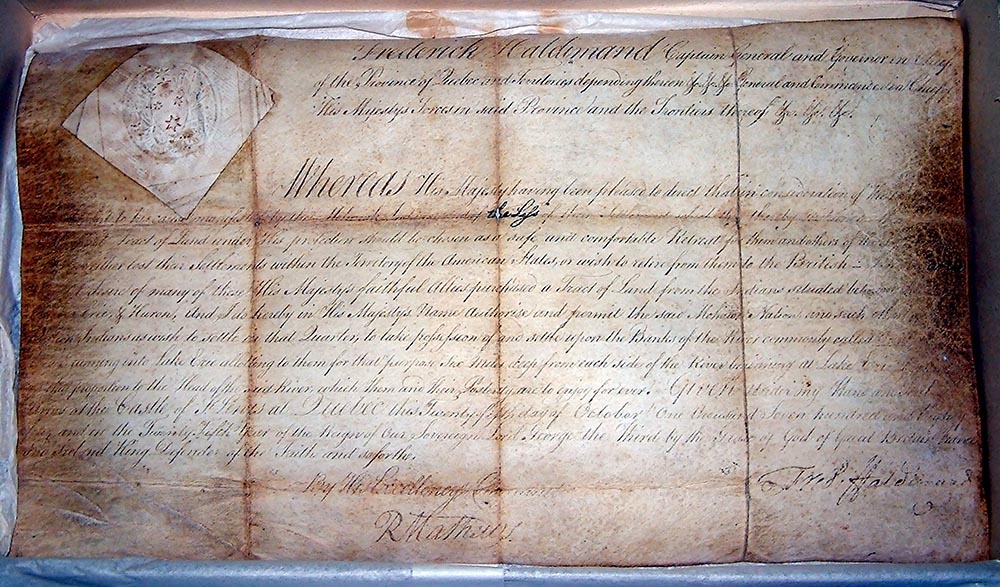
The central instrument then becomes the Haldimand Proclamation of October 25, 1784. It describes a defined corridor along the Grand River—six miles deep on each side—and uses perpetual language: a tract set apart for the Mohawk Nation (and others settling with them) “which them and their posterity are to enjoy for ever.” This is not poetic flourish. In legal drafting, “for ever” signals an enduring commitment unless lawfully modified or extinguished.
This is why the Grand River corridor is argued to be unlike most other territories in Canada. The Mohawk position is not that the land was a charitable grant or a revocable provincial allocation. It is that the territory was acquired through alliance, then acknowledged, set apart, and confirmed in perpetuity for exclusive use and enjoyment by Mohawk Loyalist posterity.
When the British North American constitutional structure evolved in 1791, the argument is that prior commitments were carried forward rather than erased. When Confederation occurred in 1867, provinces did not establish themselves on empty legal terrain.
Section 109 of the Constitution Act, 1867 is crucial here. It provides that provincial lands and resources are held “subject to any Trusts existing in respect thereof, and to any Interest other than that of the Province in the same.” That clause is not decorative. It means provinces did not inherit unburdened title. They inherited lands subject to prior trusts and interests.
If the Grand River tract constitutes such a prior interest—set apart for exclusive use and enjoyment in perpetuity—then provincial authority within the corridor is constitutionally constrained.
This is the logic of burdened sovereignty: Crown sovereignty is not necessarily sovereignty without obligations. It can be sovereignty constrained by earlier commitments that remain legally operative.
That produces the central constitutional question running through this feature:
Whether a territory set apart in perpetuity for a political nation was ever lawfully absorbed into unilateral provincial sovereignty.
A serious feature has to acknowledge Canada’s orthodox counter-position. Canadian courts have generally framed Indigenous rights as internal to Canadian sovereignty rather than parallel to it. The mainstream view treats section 35 of the Constitution Act, 1982 as recognizing existing Aboriginal and treaty rights within Crown sovereignty, not as recognizing independent statehood. Indigenous nations are often understood as holders of protected rights, not counterpart sovereigns operating on a separate plane.
The Mohawk inquiry does not ignore that jurisprudence. It interrogates the assumption beneath it.
Because the hinge is extinguishment.
In Canadian law, extinguishment of Aboriginal title or rights requires “clear and plain intent.” It cannot be presumed lightly. If Mohawk territorial and political interests in the Grand River corridor were never lawfully surrendered or extinguished, administrative expansion cannot dissolve them. Routine is not consent. Overlay is not extinguishment.
This is where a concept that many readers intuitively grasp—though they may not call it this—becomes useful: latent title defects.
In property systems, a defect can exist beneath the surface of a registry. Everything can look orderly on paper while a deeper problem sits in the chain of authority. Applied to Indigenous land interests, the idea is not that every homeowner is suddenly “illegal.” It is that Crown-issued titles can carry constitutional vulnerability if they were granted in a way that unjustifiably infringed an unextinguished underlying interest. The defect can remain dormant until litigation or negotiation forces the foundational question into the open.
This is not merely theoretical. In Cowichan Tribes v. Canada (Attorney General), 2025 BCSC 1490, the Supreme Court of British Columbia recognized Aboriginal title in Richmond and declared that certain fee simple titles and interests held by Canada and the City of Richmond were “defective and invalid,” while suspending the effect to allow time for arrangements and negotiation. The case has become a widely discussed illustration of how Aboriginal title can function as a “prior and senior” interest that creates real consequences for Crown and municipal holdings when foundational issues are adjudicated.
The most prominent litigation on the public record is the Six Nations of the Grand River litigation against Canada and Ontario, which is commonly framed as seeking compensation for alleged historical wrongs—improper alienation, failure to set aside lands, and mismanagement of proceeds—rather than private-property reclamation. Government briefing material indicates Phase 1 of that case is scheduled to commence in October 2026, with an expected duration measured in years. This matters for a feature not because it is the Mohawk position, but because it shows how long foundational issues can remain structurally unresolved while the administrative layer grows thicker above them.
International law adds another layer of vocabulary.
The United Nations Declaration on the Rights of Indigenous Peoples affirms self-determination and affirms that Indigenous peoples have rights to lands, territories, and resources they have traditionally owned, occupied, or otherwise acquired. In this feature, UNDRIP functions as a modern normative mirror: it forces a contemporary state to confront the mismatch between administrative control and foundational commitments.
Statehood enters this article not as theatre, but as analysis.
Under the Montevideo Convention’s descriptive criteria for statehood—defined territory, permanent population, government, and capacity to enter into relations—the question is not “declare a new country tomorrow.” Recognition is political, and modern recognition regimes are complex. The value of Montevideo here is conceptual clarity: it helps readers distinguish cultural identity from political continuity.
Applied analytically, the Grand River corridor is argued to present an unusual convergence of features. A territorially described corridor set apart in perpetuity. A population linked by descent and continuity. Governance mechanisms, including increasingly formalized registries and structures aimed at preserving continuity outside the Indian Act framework. And historical capacity for alliance and treaty relations with the Crown. Whether one agrees with every conclusion, the structure of the inquiry is not frivolous: it is a way of asking whether what Canada treats as “internal accommodations” were once acknowledged as nation-to-Crown commitments that were never lawfully extinguished.
Surveillance history returns here with its real significance.
When foreign sleeper narratives arise, the state treats them as threats because they imply covert subversion of law and public order.
Indigenous constitutional consciousness is the opposite. It seeks alignment with law, not evasion of it.
Yet the record shows Indigenous activism has sometimes been monitored under security frames. During the 1990 Oka Crisis, a land dispute in Kanehsatake escalated into a 78-day standoff involving the Sûreté du Québec, the RCMP, and ultimately the Canadian Armed Forces. The episode marked a turning point in how Indigenous land assertions were categorized within national security institutions. In the years that followed, CSIS and other agencies monitored Mohawk communities such as Kahnawake and Kanehsatake under headings that included “Native extremism,” “insurgent”, gathering intelligence on political mobilization and land defense activities. Later disclosures and reporting revealed how broadly such monitoring was framed. In 2010, the Canadian military formally apologized after training materials listed certain First Nations groups alongside terrorist organizations.
Infrastructure also matters, but only in the right way.
The Grand River corridor is not remote. It is geographically central to southern Ontario’s economic and logistical life. Highways, municipal systems, and core state infrastructure intersect territory that foundational instruments describe as set apart for exclusive use and enjoyment. The point is not to imagine disruption. The point is to reveal how thoroughly the tertiary layer—administration and enforcement—has embedded itself physically, and how that embedding can bury the primary foundation beneath normal routines.
The density of Canadian infrastructure on the tract does not make the Mohawks dangerous. It makes the constitutional question unavoidable. Where territory is treated as ordinary provincial space for generations, administrative habit hardens into assumption. Reconciliation becomes harder because the system confuses repetition with legitimacy.
So reconciliation has to be defined carefully.
Reconciliation here cannot be reduced to symbolic recognition or a consultation checklist. It has to mean structural alignment: Ontario and Canada reconciling their systems with the directors of foundational commitments—set-apart language, exclusive use and enjoyment, prior interests preserved against provincial absolutism, and the legal requirement that extinguishment cannot be presumed.
That is the practical meaning of burdened sovereignty: not chaos, not hostility, not withdrawal from coexistence, but an honest hierarchy. The administrative layer is real, but it is not automatically the foundation.
For Mohawk families along the Grand River, this is not abstract theory. It is the question of what legal inheritance their children are born into: Canadian citizenship alone, or layered political identity grounded in instruments that purport to set a territory apart for Mohawk Loyalist posterity “for ever.”
This is why the sleeper metaphor should be reclaimed and narrowed.
We are not talking about sleeper cells.
We are talking about sleeping rights.
Sleeping on rights is not threatening one’s neighbors. It is forgetting to examine the foundation beneath the infrastructure. And when the world becomes unstable—when states defend sovereignty abroad and monitor allegiance at home—internal foundations matter more, not less.
The issue is not conflict.
It is coherence.
And coherence begins by distinguishing between what was acquired, what was set apart, what was confirmed, what was never lawfully extinguished, and what remains legally operative beneath the surface.
Leave a Reply