
|
Getting your Trinity Audio player ready…
|
Brantford calls it the West Brant Access Route. In municipal terms, it is a Schedule C Environmental Assessment studying a new north–south arterial corridor and a new crossing of the Grand River. The project is framed as congestion relief for a growing west end, redundancy for emergency services, and infrastructure necessary to support continued expansion.
But beneath the traffic counts and conceptual renderings lies a question that has followed every proposed crossing along this stretch of river for decades: by what authority does the Crown — municipal or provincial — construct permanent infrastructure across land whose underlying constitutional exclusivity has never been publicly extinguished?
This is not a new dispute.
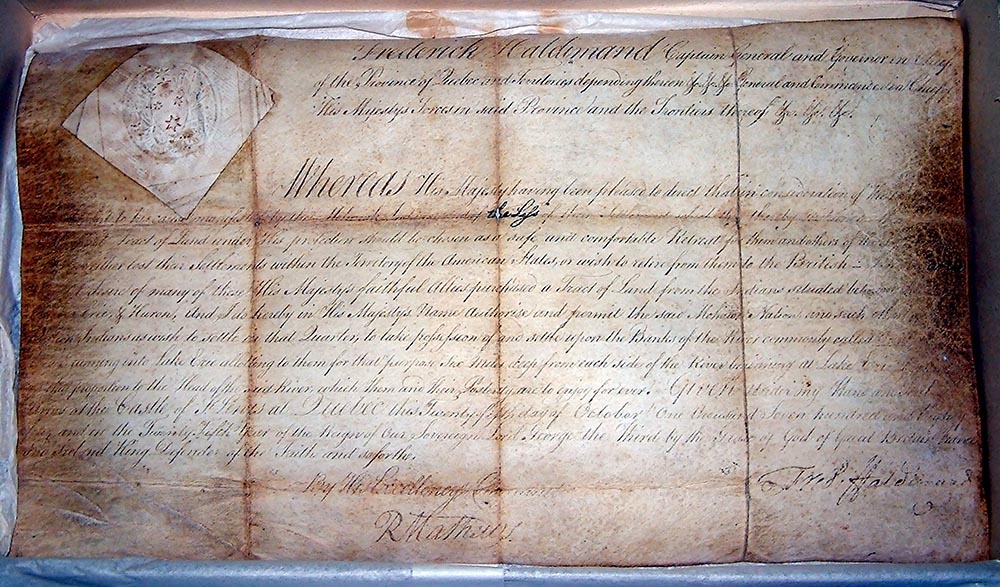
In 1991, Riverfest opened with a reenactment of Joseph Brant’s historic ford across the Grand River. The headline read, “Brant’s ford ceremony opens Riverfest weekend.” The ceremony was not merely heritage theatre. It was a reminder that the Grand River is the spine of the 1784 Haldimand Proclamation, which confirmed lands along its banks for the “exclusive use and enjoyment” of the Mohawks and their posterity.
That phrase matters. The beneficiary class described in the Proclamation is not a modern municipal corporation, nor solely an administrative entity created by statute. It is Mohawk Loyalist posterity — the continuing descendants of those to whom the Crown made its confirmation. If that confirmation remains operative in law, it burdens underlying Crown title unless lawfully extinguished.
Around that same period, another headline captured the recurring tension more bluntly: “Name the bridge ‘Wakonrori,’ I told you so!” When Councillor John Peters publicly remarked, “Why don’t you find out how to say ‘I told you so’ in Mohawk,” Turtle Island News contacted Six Nations Cayuga Royanni Jake Thomas. The translation came back plainly: “It’s Wakonrori.”
The article described a substantial steel truss bridge proposal crossing approximately 60 metres of river. The bridge would touch on an island within the Grand River territory. The City had considered placing the bridge away from the island but rejected that option due to cost. The upper deck would serve pedestrians, cyclists, and skiers. Beneath it would run a watermain and sewer pipelines contained within a system designed to prevent leakage into the river.
The response was not simply a disagreement over engineering details. The Mohawk Nation of Grand River intervened in discussions to assert that underlying beneficial interest. Their position was not framed as a policy objection or a request for mitigation. It was a title assertion.
Meetings were disrupted and frequently halted not because of span heights, but because the discussion shifted to extinguishment evidence.
Institutional awareness of the legal tension predates that article. A January 22, 1981 internal Brantford city memorandum acknowledged that Indian lands could not be expropriated and discussed exploring “a devious way” to circumvent the need for consent to build a highway over subject lands. The memo noted that permission was unlikely due to federal interest in Indian band rights.
Records preserved and left in trust by former councillor Margaret Cheshi-Smith further illuminate how that awareness operated. An internal notation regarding the Brantford Southern Access Road (BSAR) and Glenwood Drive stated that reference to the road extending beyond Brett Street was incorrect. It described the extension as “an encroachment onto Indian Lands” and noted that the road “does not have to be closed because technically, it does not exist.”
That language is administrative, not rhetorical. It reflects an understanding that physical extension does not equate to lawful existence. A roadway may appear on the ground, but if it crosses into territory beyond recognized authority, it is not acknowledged in law.
The logic is revealing. What is not recognized within the governing framework is treated as though it does not exist for legal purposes, even if it exists physically. That same administrative lens has often been applied to the Mohawk Nation of Grand River. Because it is not constituted as an Indian Act band, it is frequently treated as lacking formal standing within statutory consultation processes. In bureaucratic terms, it is regarded as outside the recognized framework.
Yet the Haldimand Proclamation did not confirm lands to an Indian Act entity. It confirmed them to the “Mohawks and their posterity.” That confirmation predates the Indian Act by nearly a century. Administrative recognition under a later statute cannot retroactively define or extinguish a prior constitutional confirmation.
The (BSAR) later demonstrated how such tensions can culminate. Dr. Michael Doxtater has stated that Consecration legislation was invoked by Canadian lawyers to support opposition to BSAR through the Glebe lands and that the road was ultimately declared dead. There is no single court judgment declaring that consecration law alone defeated the project. The City halted it. Records indicate that the Province would have owned a percentage of the roadway.
That episode was not merely a legal confrontation. It was a community mobilization. Residents of the surrounding neighbourhood and Mohawk citizens banded together to protect both the community and the lands from the proposed Oak Park expansion. Public meetings were heated. Positions hardened. Ultimately, council voted to halt the project, with several members reversing earlier support.
That detail matters. Provincial ownership of infrastructure across potentially burdened land engages Section 109 of the Constitution Act, 1867, which vests provincial lands “subject to” existing interests, and Section 35 of the Constitution Act, 1982, which recognizes and affirms existing Aboriginal and treaty rights. The collapse of BSAR may have reflected recognition that the constitutional risk profile was too high.
The pattern extends beyond Brantford. In Caledonia, an aging bridge along the same Grand River corridor has raised infrastructure concerns. Consent for certain works has reportedly been withheld not only at the administrative level but by Mohawk authorities asserting exclusive use and enjoyment interests. When multiple crossings along the same river face consent disputes, the issue becomes corridor-wide.
An aging infrastructure creates a dilemma. The Province must balance public safety obligations against unresolved jurisdiction. Proceeding without consent risks constitutional breach. Delaying intervention risks safety exposure. Negotiation implicitly acknowledges unresolved title. The dilemma itself signals that the legal status of the corridor is not conclusively settled.
The riverbed question remains central. Sacred-site debates can be factually complex. The riverbed issue turns on documentary evidence. Was the bed of the Grand River within the Haldimand tract ever lawfully surrendered by the beneficiary class described in 1784? Was it alienated free and clear of Mohawk Loyalist posterity’s confirmed interest? Is there extinguishment evidence?
Bridges require piers anchored in that bed. Environmental Assessment approval mitigates environmental impact; it does not cure defective title. Canadian law often presumes that the bed of a navigable river is vested in the Crown, but that presumption operates subject to prior interests. If the Haldimand Proclamation confirmed exclusive use and enjoyment along the river corridor, that burden persists unless lawfully extinguished.
When the Mohawk Nation of Grand River asserts exclusive use and enjoyment rights grounded in the Haldimand Proclamation, governments may respond that it is not recognized under the Indian Act. Yet the 1784 confirmation predates the statute by nearly a century. Administrative non-recognition does not resolve constitutional burden.
Municipal authority is delegated authority. The City of Brantford exercises powers granted by the Province. It cannot exercise greater rights than the Province possesses. If provincial title remains burdened by an unextinguished beneficial interest confirmed in 1784, municipal infrastructure planning rests on assumption rather than settled title.
There is also a political arc. Under previous mayoral administrations — from Bob Taylor to Chris Friel — development in contested areas appeared effectively halted pending due process. That posture did not resolve title but functioned as a brake. Before Kevin Davis became mayor, a private meeting took place in which the issue of exclusive use and enjoyment under the Haldimand Proclamation was discussed directly. Entering that meeting with a three-decade legal veteran, the author recalls Davis extending his hand and stating, “I hope you know I’m a lawyer.” The discussion centered on whether the Crown’s oath of allegiance and oath of office requires officeholders to observe the exclusive rights confirmed in 1784.
The underlying interests were not abstract. Chief Richard Maracle had informed the City of Brantford of the existence of those interests in relation to lands slated for development. Prior to construction on the former Canadian Tire property, the CEO of Cachet was formally notified of the asserted underlying interests connected to the Haldimand confirmation and the exclusive use and enjoyment rights of Mohawk Loyalist posterity. Despite that notice, the former Canadian Tire site was developed. The Havendale project by Cachet — promoted as “A Bold New Haven in Brantford” — is now in its early phases. The constitutional question raised before development remains unanswered after it.
Under Mayor Davis, the tone shifted. The phrase “fortune favours the bold” came to light through a Freedom of Information request related to the sale of Arrowdale Golf Course lands — lands that had been dedicated to the City and customarily used as golf course property. The disclosure revealed the language within correspondence surrounding the disposition of those lands. The same Freedom of Information release included reference to the Athenian Oath, a civic principle historically associated with doing no harm and leaving the city better than one found it.
That contrast is difficult to ignore. Boldness in governance can signal confidence and decisiveness. But where foundational constitutional questions remain unresolved, boldness can also resemble a rush to judgment. In circumstances involving disputed underlying interests, acting without resolving title risks more than controversy — it risks structural error. When development proceeds across lands subject to unresolved beneficial interests, the consequences are not merely political. They can place communities in prolonged conflict, expose residents to legal uncertainty, and intensify jurisdictional tension. The question becomes whether boldness, in such circumstances, aligns with the obligation to do no harm.
Boldness may accelerate growth. It does not produce a surrender instrument. It does not extinguish exclusive use and enjoyment confirmation. It does not dissolve a corridor-wide pattern in which crossings are repeatedly contested.
The West Brant Access Route is presented as a transportation solution. Growth pressures are real. Infrastructure is necessary. But planning benefits do not override constitutional burden. Efficiency does not extinguish confirmed beneficial interest.
The old headline now reads less like wit and more like warning. “Wakonrori — I told you so.” The City hoped to move ahead. Mohawk representatives insisted on examining the foundation first. Meetings stalled not over engineering details but over unresolved title.
If the Province believes the riverbed within the Haldimand tract was lawfully surrendered, it should be able to produce the instrument. If it cannot, the burden question remains live.
Bridges can span water. They cannot erase constitutional confirmation. They cannot extinguish unceded beneficial interest.
The river has memory.
Wakonrori.
Leave a Reply