
|
Getting your Trinity Audio player ready…
|
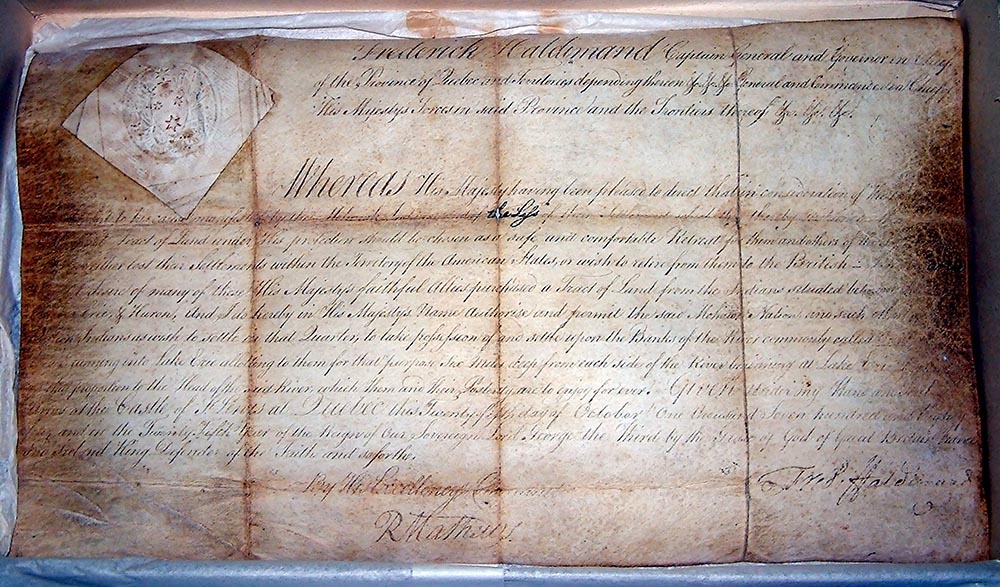
The ongoing litigation advanced by the Six Nations Band of Indians, through named litigants Lonnie Bomberry and Phil Montour, is often described as a way to resolve historic land grievances along the Grand River. That description is incomplete. It merges different legal questions into one storyline and, in doing so, hides a more serious issue: the Grand River settlement is being treated like a normal domestic “land claim,” when the governing instruments point to something different—an existing constitutional obligation tied to an acquired-territory settlement and a Crown promise directed to Mohawk Loyalist posterity.
This is not mainly a debate about whether land administration went wrong. It is a debate about what the Haldimand instruments are, who they were made for, what they require, and whether Canada can repackage those duties into policy processes that were never built to address this kind of undertaking.
How the matter is framed determines what follows. If the Haldimand Proclamation is treated as just another claim file, the remedy becomes negotiable and discretionary: negotiations, settlement packages, staged timelines, and delay. If it is treated as an existing duty already inside Canada’s constitutional structure, the remedy is different: clarity, recognition, and compliance with what was already promised.
How the “claims process” displaced the original question
The early effort to press Mohawk land questions did not begin inside Canada’s later comprehensive claims framework. It began through discussions between Mohawk leaders and ministers in the House of Parliament, when Canada had no settled mechanism to deal with the Haldimand instruments.
Mohawk leadership, including Mel Hill (then a chief), worked with advocates such as Mad Bear Anderson to bring attention to the issue and to press for a principled resolution grounded in the original Crown undertakings.
Early legal counsel was deliberately sought outside Canada. Mohawk leadership retained Gobiatchi, a lawyer from the United States, because he was seen as independent from Canadian institutions. He took the position that hiring Canadian counsel at the outset risked a built-in conflict, since Canada was the party whose obligations were being questioned. When the strategy later shifted and Canadian counsel was retained, Gobiatchi ended his representation. Before stepping away, he helped advance the matter by arranging communications and meetings connected to federal ministers, raising the issue’s profile when Canada still lacked a clear legal path to address it.
Those early letters, meetings, and representations were later compiled into a volume commonly known in the community as The Red Book, formally titled The Claims of the Mohawk Nation of Grand River. It captures how the issue was presented to Canada before modern claims programs took shape. A reprinted edition has been prepared to improve public access and will be hosted alongside this article on SixMilesDeep.com so readers can review that record directly.
Despite those efforts, Mohawks were repeatedly encouraged to keep sharing ideas while Canada developed a process—and to wait while that machinery was built. Years passed without a meaningful resolution.
When Canada later introduced comprehensive and specific claims systems, those mechanisms were designed mainly to address breaches of fiduciary duty, reserve administration problems, and unlawful dispossession under Canadian law. They were not designed to decide a foundational question about the constitutional character of an acquired-territory settlement. Nor were they built to test standing for a defined beneficiary group tied to Loyalist-era instruments.
Nonetheless, Six Nations elected leadership proceeded to file a large number of claims, with research work substantially advanced by Phil Montour. That research may help document misconduct and mismanagement. But it does not answer the deeper question. The core issue is not only how land administration failed. The core issue is what the Crown pledged, to whom it was pledged, and what legal effect Canada’s later confirmation had.
The Haldimand instruments as part of Canada’s constitutional foundation
The Haldimand Proclamation is not a normal deed and not a standard reserve creation. It describes an acquired-territory settlement tied to Mohawk Loyalist posterity and framed as an exclusive-use undertaking.
When Canada formed and later operated within a constitutional structure, it confirmed the Haldimand instruments to uphold the honour of the Crown and to pledge the faith of government to the Mohawk people on a perpetual basis. In plain terms, confirmation matters because it turns a promise into a continuing duty. It means the obligation does not live only in history or politics. It lives inside the rules Canada relies on to claim legitimacy today.
Canada cannot reasonably rely on the benefits of sovereignty while treating a foundational undertaking as optional, “policy-based,” or indefinitely postponable. If the Haldimand Proclamation is embedded at the foundation of the relationship, then the question is not whether Canada will someday design a remedy. The question is whether Canada will honour what it already undertook.
“Exclusive use and enjoyment” is not the same as a modern collective-rights model
A recurring mistake in public discussion is to treat the Grand River settlement as a general “collective rights” issue in the modern sense. The Haldimand instruments, read on their own terms, do not operate that way.
Using a straightforward “Four Corners” approach—reading the instrument by what it says, not by what later systems wish it said—the language points to a defined posterity: Mohawk Loyalists and those properly within that beneficiary designation.
The phrase “such others,” in ordinary legal usage, does not automatically expand the beneficiary class without limit. It commonly refers to people outside the core undertaking, not a tool for overriding a named beneficiary structure.
This matters because standing cannot simply be assumed through modern administrative membership systems that were not created to identify Mohawk Loyalist posterity. A membership system may serve governance and program purposes. It does not, by itself, prove the lineage-based beneficiary status that a hereditary designation requires.
Numbered treaties, the Simcoe Patent, and why rejection still matters
Canada’s numbered treaties are a post-Confederation system. They developed after 1867 as domestic instruments used to facilitate settlement and resource development, especially in the West. They are not the legal world of 1784.
One early instrument often mentioned in Grand River discussions is the Simcoe Patent. Whatever label is applied to it, the key point is simple: it was rejected at the time because it failed to secure exclusive use and enjoyment. Its structure moved the land toward marketability—toward division and transfer in ways that weaken exclusive possession. The Haldimand Proclamation was preferred precisely because it did not do that.
That historical choice still matters. It clarifies what kind of arrangement was accepted and what kind was refused. The issue is not “any document will do.” The issue is the nature of the commitment: exclusive use and enjoyment versus arrangements that allow the land to be treated like market property.
Objection, non-consent, and why intervention was not the right tool
In my capacity as Secretary-General of the Mohawk Nation of Grand River, formal objections were issued to the Six Nations Band of Indians litigation and to the assumptions of representative capacity associated with it. Notices of non-consent were also sent to the litigants and relevant entities. These objections were categorical: Mohawk hereditary interests and Mohawk Loyalist posterity do not concede representation through a membership-based collective framework that is not built to prove the beneficiary designation at issue.
This is not just a political disagreement. It has direct legal consequences. In 2024, I raised a constitutional challenge directed to the Crown and sought a declaration recognizing the Mohawk Nation of Grand River’s exclusive use and enjoyment under the Haldimand Proclamation. The court declined to grant that declaration while a similar declaration was being sought in the Six Nations litigation. In practice, once a collective lawsuit seeks “exclusive use and enjoyment,” other pathways are treated as overlapping or premature—even where the instruments and standing theories differ.
This is why the Mohawk Nation of Grand River chose not to intervene. Intervention does not force a case to be reframed. Interveners generally speak within the frame already set by the main parties. They do not control pleadings, do not run the case, and cannot compel proof of standing in the way a principal party can. Seeking intervener status can also be misunderstood as conceding legitimacy to the framework.
Maintaining autonomy preserves the ability to address the constitutional character of the Haldimand instruments directly, without being absorbed into a structure that, by default, treats the matter as a collective land-claims dispute.
What is actually at stake
The issue before the courts and the public is not only whether Canada will honour a pre-existing constitutional obligation or reduce it to a negotiable claim. It is whether this relationship will be governed by law or by arbitrariness—by procedural shortcuts that treat fundamentally different things as if they were the same.
Protection against arbitrariness is not abstract. Article 15 of the Universal Declaration of Human Rights affirms the right to a nationality and prohibits arbitrary deprivation of it. Treating the Mohawk Nation of Grand River as interchangeable with an administrative band structure collapses two distinct legal concepts and risks erasing nationhood through process rather than through any lawful decision.
A nation and an administrative body are not equivalents. They draw authority from different sources, occupy different legal positions, and cannot cancel one another by implication. Folding Mohawk national standing into litigation framed around an elected band structure is not a neutral procedural choice. It is a shortcut that sidelines Mohawk autonomy instead of addressing it directly.
For the Mohawk Nation of Grand River, what is at stake is survival and continuity: the right to exist as a nation within its own domain, the right to the lands pledged under the Haldimand settlement, and the right to recover those lands in accordance with law. That recovery is not about compensation alone. It includes restored jurisdiction, recognized title, and correction of property arrangements created in violation of a known constitutional obligation.
The Haldimand Pledge and Proclamation did not promise a future negotiation. They confirmed a status grounded in alliance, loyalty, and territorial security. That act was not provisional. It was done.
What is also at stake is the honour of the Crown. If foundational undertakings can be reinterpreted until they no longer bind, then honour becomes rhetoric rather than a constitutional constraint.
Reconciliation is implicated as well. Truth and reconciliation cannot coexist with selective memory. The Grand River lands were set apart under a constitutional undertaking that has never been lawfully extinguished. Reconciliation cannot mean asking Mohawks to forget that fact for the sake of convenience.
The Haldimand settlement was not about a payout. It was about a promised land. Nearly 250 years have passed under that agreement. What is at stake now is whether the Mohawk Nation of Grand River will be allowed to endure under the terms pledged, or whether it will be gradually dissolved into frameworks that deny its original standing.
That is what is at stake.
Leave a Reply