
|
Getting your Trinity Audio player ready…
|
Across North America, Indigenous self-determination is no longer confined to court filings or archival debates. It is re-entering public life in practical form — through land-use decisions, housing priorities, registry systems, negotiations over overlapping interests, and the gradual construction of institutions capable of governing if older constitutional obligations are finally taken seriously.
Recent developments in British Columbia have made that shift visible. In early March 2026, K’ómoks First Nation announced the closure of the Queneesh Mobile Home Park on reserve lands, effective January 31, 2028. Residents received roughly two years’ notice to relocate so the Nation could address housing shortages for its own members. While much of the public attention centered on tenant distress and relocation pressures, the Nation presented the decision as an exercise of responsible governance rooted in its underlying land interests.
The 2025 British Columbia Supreme Court ruling in Cowichan Tribes v. Canada raised similar tensions in a different form. There, Aboriginal title was recognized over portions of Richmond, forcing renewed attention on the overlap between Indigenous interests and lands long treated as securely embedded within external systems of administration and title. By early 2026, Musqueam-Crown developments further highlighted how fragile assumptions about certainty can become once underlying Indigenous interests are treated seriously.
Across the border, the Saint Regis Mohawk Tribe’s April 2025 land return through United States legislation championed by Congresswoman Elise Stefanik offered another example of historic obligations resurfacing in modern administrative form. What had long been treated as settled became active again through governance, land recovery, and community-directed development.
These examples are not identical to the situation in Mohawk Nation of Grand River Country. But they expose a broader truth: unresolved Indigenous land interests do not disappear simply because outside governments built administrative systems on top of them. They can re-emerge decades later, not first as theory, but as governance.
The Foundation: A Prior Constitutional Burden
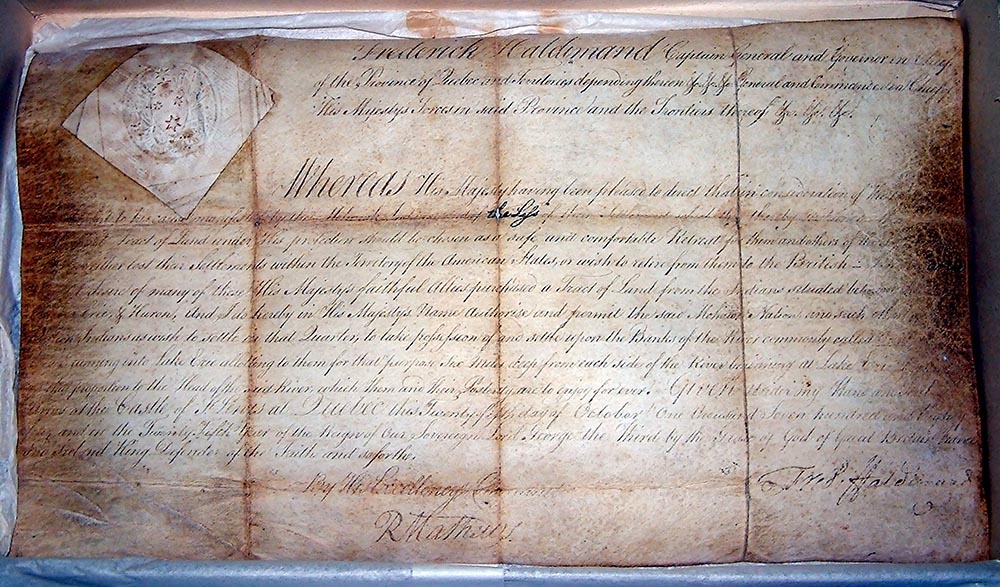
At the centre of the Grand River position is the Haldimand Proclamation of October 25, 1784. For Mohawk advocates the familiar language of lands set apart for the Mohawk Nation and their posterity “to enjoy for ever” is not ornamental. It signifies an acquired territorial interest, one held for posterity, one tied to Crown honour, and one that later systems were bound to respect rather than erase.
The argument is not that outside governments lack existence. It is that any administration established within the acquired territory entered subject to this prior constitutional burden. Those obligations did not dissolve with time, nor were they displaced simply because administrative systems expanded across the territory and eventually came to appear normal.
Section 109 of the Constitution Act, 1867 is often invoked in that regard because it confirms that ownership of lands remains subject to existing interests. From this perspective, external systems did not acquire unencumbered title. They assumed administration subject to the prior dedication of acquired territory and the obligations attached to it.
Exclusive Use and the Question of Priority
The phrase “exclusive use and enjoyment” carries legal weight. It speaks to the beneficial interest in land — the right to occupy, control, direct use, and derive benefit. Mohawk advocates interpret the Haldimand dedication as preserving that underlying interest within the acquired territory.
If so, then later systems — roads, municipalities, registries, licensing schemes, insurance frameworks, and public administration — are not foundational. They are overlays.
When competing interests occupy the same land, law usually turns to priority. The earlier interest is senior. Later systems must operate around it. From this perspective, Mohawk rights are not one interest among many. They are the prior interest.
That does not erase the modern world. It does not mean roads vanish overnight or municipalities simply disappear. But it does reframe those structures. They may continue to exist in practice, but they do so subject to the prior dedication of acquired territory.
This is one reason the Grand River question is so difficult for outside systems to confront. It is easier to assume that long administration settled the matter than to ask whether long administration merely obscured an older burden.
Movement, Safety, and the Limits of Assumed Authority
Transportation reveals the tension immediately.
Roads, licences, plates, insurance, and roadside enforcement all depend on a foundational assumption: that the authority regulating movement has clear jurisdiction over the territory in question. External transportation frameworks proceed on precisely that assumption. If a vehicle is not registered and insured under recognized external systems, the driver is typically treated as personally exposed to liability.
But from a Mohawk perspective, that operational answer does not resolve the prior constitutional question.
If the acquired territory remains subject to Mohawk exclusive use and enjoyment, then movement within it is not merely an external privilege. It is tied to a prior right. That is why roadside interactions can become constitutional flashpoints. What appears, on the surface, to be a simple enforcement question — “Are you properly insured?” — may actually conceal a deeper one: who has authority to define what lawful registration, lawful insurance, and lawful movement mean in the first place?
The Mohawk National Vehicle Registry Initiative (NVR), formally notified on October 31, 2024 to Ministers Prabmeet Sarkaria, Peter Bethlenfalvy, and Michael Kerzner, arises directly out of that problem. The initiative asserts authority over vehicle registration, driver training, and safety within the acquired territory. It includes distinctive plates referencing the Haldimand Proclamation of 1784 and integration with the Grand River Nationalized Driver Insurance Policy (GRNDIP). The point is not symbolic novelty. The point is to show that movement, liability, and safety can be administered under Mohawk governance.
That matters because a right that cannot be administered is vulnerable to being dismissed as theoretical.
Housing, Land Records, and Administrative Continuity
The same logic applies to land and housing.
The Mohawk Nation Housing Initiative (MNHI), notified on November 3, 2024 to Ministers Paul Calandra and Doug Downey, sets out a parallel framework for reclaiming unused properties, supporting community development, preserving heritage, and establishing a Mohawk Lands Registry to document hereditary and treaty interests. The initiative invokes the principle of status quo ante bellum flowing from the 1779 Haldimand Pledge and seeks to restore pre-war conditions consistent with Mohawk sovereignty over acquired territory.
This is an important shift in emphasis. Too often, Indigenous rights are discussed only in terms of grievance, protest, or historical wrong. But the practical exercise of jurisdiction requires more than memory. It requires records, procedures, notices, registries, standards, and a system capable of functioning before full recognition arrives.
In that sense, housing and land-record initiatives are not secondary to the constitutional argument. They are among its most important expressions.
The Latent Defect in Title
Another way to understand the Grand River situation is through the concept of a latent defect.
In ordinary property law, a latent defect in title is a hidden problem in the chain of ownership — something not obvious on the surface of the registry, but still real in law. A land system can function for decades before such a defect becomes visible.
Mohawk advocates argue that the Grand River issue involves something even deeper: not only a latent title defect, but a latent constitutional burden.
On this view, the Haldimand dedication never disappeared. It remained embedded beneath external systems of title, taxation, infrastructure, insurance, and development. Administrative certainty grew up around it, but certainty of administration is not the same thing as certainty of constitutional right.
That distinction becomes especially important when people invoke the language of innocent third-party purchasers. Many residents purchased homes, farms, or businesses in good faith. They relied on registries, approvals, lenders, insurers, and the assumption that what was being conveyed was secure. Their good faith is real.
But good faith cannot create a title that never existed free and clear in the first place. No one can transfer what they do not own. If the underlying constitutional burden remained, then later transactions may still be subject to it, even where the purchasers themselves acted honestly.
That does not make ordinary residents the enemy. It means the risk cannot simply be placed on the people to whom the original constitutional obligation was owed.
Licensing, Infrastructure, and Revenue
If acquired territory is to be understood as subject to Mohawk exclusive use and enjoyment, then the question is not only who holds rights, but how those rights are expressed in practice.
One of the clearest expressions of jurisdiction is licensing.
Modern governments operationalize authority through licensing, permitting, registration, insurance standards, utility agreements, rights-of-way, and access conditions. If Mohawk jurisdiction is real, then it cannot remain frozen at the level of abstract declaration. It must extend into the practical governance of participation within the territory.
That includes vehicles, development, communications infrastructure, energy corridors, telephony, land access, and other systems that profit from or depend upon the land.
From a Mohawk perspective, if outside persons, corporations, or public bodies wish to operate within the acquired territory, then their presence is not automatically self-authorizing. It may properly require Mohawk licensing, Mohawk insurance recognition, Mohawk-issued permissions, or Mohawk infrastructure agreements. This is not unusual in principle. It is how jurisdiction is ordinarily expressed elsewhere.
It also has economic consequences.
Licensing and permitting are not just regulatory tools. They are revenue tools. They allow governments to set terms, manage risk, and generate income tied to the use of land and infrastructure. If Mohawk institutions are to exercise jurisdiction meaningfully, they must be able not only to assert control, but to derive the practical and economic benefits that follow from control.
That includes the underlying rights associated with roads, utilities, telecommunications systems, and other infrastructural uses that have long been treated as though they existed independently of the acquired territory beneath them.
Enforcement, Oath, and Process
The problem, however, is not solved simply by asserting jurisdiction. It must be understood and operationalized by those who currently act on the land.
Police and municipal officers generally proceed on the assumption that external law applies uniformly. Their training, mandates, and enforcement patterns reflect that assumption. But if the legal landscape includes prior constitutional obligations tied to Mohawk exclusive use and enjoyment, then those assumptions are incomplete.
This does not require confrontation. It requires process.
If officers have sworn oaths to uphold the constitutional order, then the obligations embedded in that order cannot be treated as irrelevant merely because they are inconvenient or unfamiliar. The goal is not court. The goal is to create a framework in which officers, municipalities, and administrators understand that they operate subject to a deeper constitutional landscape than ordinary administrative habit acknowledges.
That means developing protocols.
It means recognizing Mohawk-issued documentation where appropriate. It means creating administrative pathways for resolving jurisdictional questions. It means ensuring that police and municipal bodies cannot simply say they lacked notice or lacked understanding of the constitutional issue once that notice has repeatedly been given.
Without such process, every interaction risks becoming a conflict. With it, overlapping jurisdictions can at least begin to be managed.
Sustained Dialogue and Notice
These initiatives did not emerge in isolation. They have been accompanied by years of sustained engagement.
On October 17, 2023, MP Leslyn Lewis met with Mohawk University representatives at HM Royal Chapel of the Mohawks to discuss the Drivers Program and Housing Initiative. The Two Row Times edition of October 18, 2023 reported Lewis’s interest and noted positive dialogue involving OPP, CN Police, federal authorities, and the military.
On September 5, 2023, letters were sent to MP Leslyn Lewis and then-Minister Caroline Mulroney outlining the aspirations behind the transportation and housing initiatives. Mulroney’s office responded on January 11, 2024 through Donna Bigelow, acknowledging the initiatives and directing transportation-related matters toward the Indigenous Transportation Initiatives Fund while redirecting housing issues elsewhere.
Airspace assertions in February 2021 challenged RCAF 431 Squadron flights under the exclusive terms of the Proclamation. Responses from RCAF and DND noted compliance with existing procedures while declining to resolve the broader constitutional issue.
Land-registry efforts, building on earlier exchanges from 2014 to 2022 with former Director of Titles Jeffrey Lem, advanced again in December 2025 through correspondence with Director Dan Petoran and Minister Stephen Crawford seeking acknowledgment of the Mohawk Land Registry and possible mechanisms under the Land Titles Act. Petoran’s response of December 23, 2025 confirmed receipt, referenced prior engagement, and committed the matter for ministerial review.
The pattern is clear.
The Crown has been placed on repeated and sustained notice.
Acknowledgment of a proposal is not acknowledgment of jurisdiction. Administrative reply is not constitutional resolution. But governments, ministries, agencies, and public actors can no longer credibly say the issue was hidden from them. The record exists. The notice has been given. The institutions are being built.
Building Before Recognition
Across Grand River Country, Mohawk institutions are being built before formal recognition arrives.
Registries are being developed. Governance frameworks are being articulated. Transportation and housing systems are being designed. Land records are being pursued. Hereditary and posterity-based interests are being documented. Safety, liability, and licensing concepts are being thought through in administrative terms rather than left as abstractions.
In Grand River Territory, the remaining question is whether police, policymakers, and public officials will treat observance of the Haldimand Proclamation—and the Mohawk right of exclusive use and enjoyment—not as an optional political question, but as a legal duty already imposed upon them.
Leave a Reply