
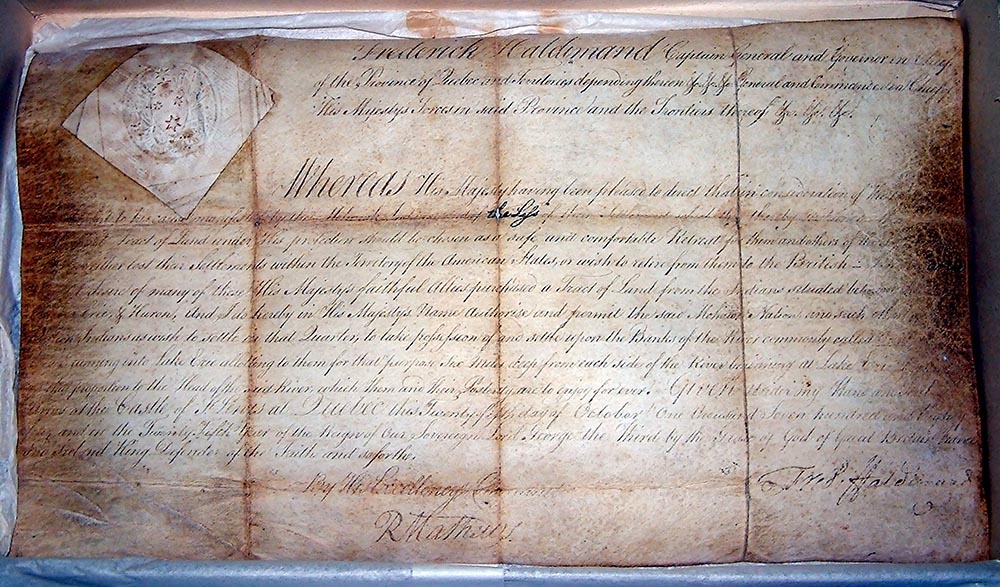
The international character of treaties is the idea that some agreements are better understood as nation-to-nation instruments than as simple domestic contracts. They are made between distinct political communities, often pre-dating modern state boundaries, and they deal with sovereignty, territory, and long-term peace rather than short-term transactions. For Haudenosaunee and Mohawk diplomacy, this is the world of the Covenant Chain and the Two Row Wampum: two peoples travelling side by side, neither subordinating the other.
Although the Haldimand Proclamation is formally a unilateral Crown proclamation rather than a signed two-sided treaty text, it sits inside this wider diplomatic universe. It is a Crown act taken in response to earlier alliances, pledges, and losses suffered by the Mohawk as Britain’s military partners. Read together with the Covenant Chain, the Queen Anne–era alliance, and later Loyalist arrangements, Haldimand looks less like a one-off land grant and more like a piece of a broader, quasi-international settlement between nations.
The international flavour of this whole story becomes clearer when you zoom out to the evolution of global dispute-resolution. In the late 19th century, Tsar Nicholas II of Russia called for peace conferences to reduce armaments and provide peaceful means of resolving disputes between states. Those conferences led to the 1899 Hague Convention and the creation of the Permanent Court of Arbitration (PCA), later housed in the Peace Palace at The Hague. The PCA was designed as a standing, neutral forum where states—and eventually other parties—could submit disputes instead of going to war. It is one of the first modern expressions of a third-party international court standing above any one government’s domestic system.
Centuries earlier, during the reign of Queen Anne, you can already see a related logic forming in the imperial relationship with the Mohawks. The 1710 Mohawk delegation to London, the building of the chapel at Fort Hunter, and the ongoing diplomatic relationship cast the Crown as something more than just another colonial player. For the Mohawks, Queen Anne was not simply the head of a distant government; she was a third-party sovereign who could stand above colonial governors and assemblies, receive petitions directly, and act as an arbiter when conflicts arose between Indigenous nations and settlers. In that sense, she functioned as an early “court of appeal” beyond local colonial politics.
Putting these threads together, the Six Miles Deep framework treats instruments like Haldimand, the Queen Anne alliance, the Covenant Chain, and the Two Row Wampum as having an international or quasi-international character:
-
They are made between distinct political communities (Haudenosaunee / Mohawk and the Crown), not merely within a domestic hierarchy.
-
They position the Crown as a third-party guarantor or arbiter, rather than as a simple owner-government.
-
They anticipate the idea that when disputes arise about land, promises, or jurisdiction, it may be appropriate to look to neutral or higher-level forums—whether that is the monarch, a privy council, or, in today’s world, international bodies like the PCA.
Seen in this light, Haldimand and related instruments are not just old colonial paperwork that provincial statutes can quietly override. They are part of a chain of nation-to-nation arrangements that resonate with the later global move toward peace conferences, international courts, and third-party arbitration. Treating them as quasi-international tools helps explain why their meaning and performance cannot be left solely to the day-to-day discretion of municipalities or provinces, and why appeals to bodies like the Permanent Court of Arbitration—or to renewed Crown-level processes—fit naturally within the story.