
Misfiling is the quiet way history gets lost without ever being officially “denied.” Instead of burning documents, systems simply misplace them: registries scattered across departments, land records filed under the wrong headings, Mohawk or U.E. identifiers dropped from newer versions of forms. Over time, evidence becomes “hard to find” rather than formally destroyed.
On the Haldimand Tract, misfiling is part of the reason posterity struggles to prove what the Crown already knew. Militia rolls, church books, survey reports, committee minutes, and early registries may sit in archives under generic labels—“misc. land papers,” “Indian affairs,” “Upper Canada”—instead of clearly tagged as part of the Haldimand system.
The effect is the same as deliberate erasure: families are told there is “no proof,” while the proof is buried in obscure folders the state has never bothered to properly index or reconcile. Six Miles Deep treats misfiling as a structural problem, not an accident, and responds by building its own curated evidentiary bundles.
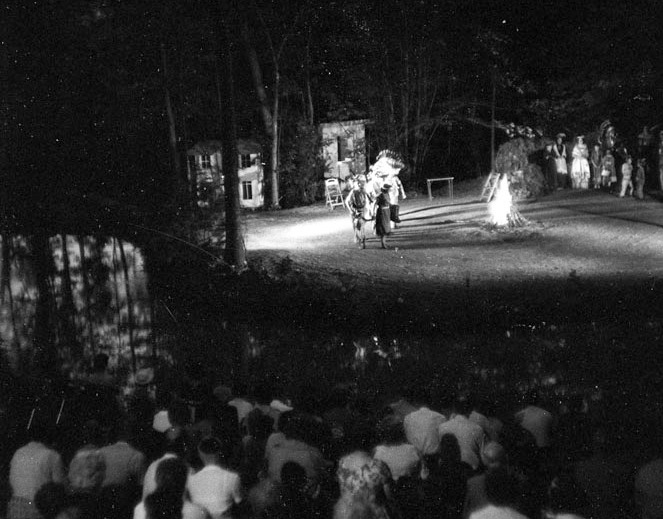
Old plays at Sour Springs Forest Theatre (Covered by George Beaver)
This play for 1989, at the Forest Theatre on Sour Springs Road, was native history told from a native perspective. Some Of the episodes depicted have never before been seen in print. They come from the oral history of the Six Nations. The play covers the trouble period after the Six Nations Iroquois were uprooted from their ancient tribal lands during the American Revolution, up to the present time.
It was called “The New Beginning” because after living prosperously for hundreds of years in the Finger Lakes region and along the Mohawk River, the Six Nations had to leave their homelands and start anew in the wilds of southern Ontario. The left the vast fields of corn, beans and squash, The Three Sisters. They left fruit orchards, villages and huge fortified buildings the European writers called castles. They came to a land barren of shelter from the elements and already depleted of fur-bearing animals. They were United Empire Loyalists as much as and Scot or Englishman but they have never been called that because they were natives. And they have rarely been treated as U.E.L.s.
One of the lessor kn1own episodes which occurred in the 1840’s is depicted in this years play. When white squatters began encroaching on Six Nations land by the Grand River, the Six Nations Council, which consisted of Chiefs of the Confederacy, appealed to the Canadian government to control their people. Agents were sent out to request the squatters to move but they demanded payment for the building, fences, etc.,that they had put up.
The government decided it would be easier to move the Indians across the Grand River. The squatters were only too happy to assist in this and there are stories passed down by word of mouth of the white squatters driving the Indians across the river with clubs and pitchforks.
This occured along the river south of Brantford, from Cainsville to Onondaga and from Middleport to Caledonia. The Tutelos, who lived at what is now called Tutela Heights, were also driven out in the same fashion. Some of their ceremonies still survive in the Longhouse rituals at Six Nations.
It has been said that those who do not learn from their history are doomed to repeat it. However, before y1ou can learn from it, you have to know what your history was.
This year’s Six Nations Pageant told it like it was.