
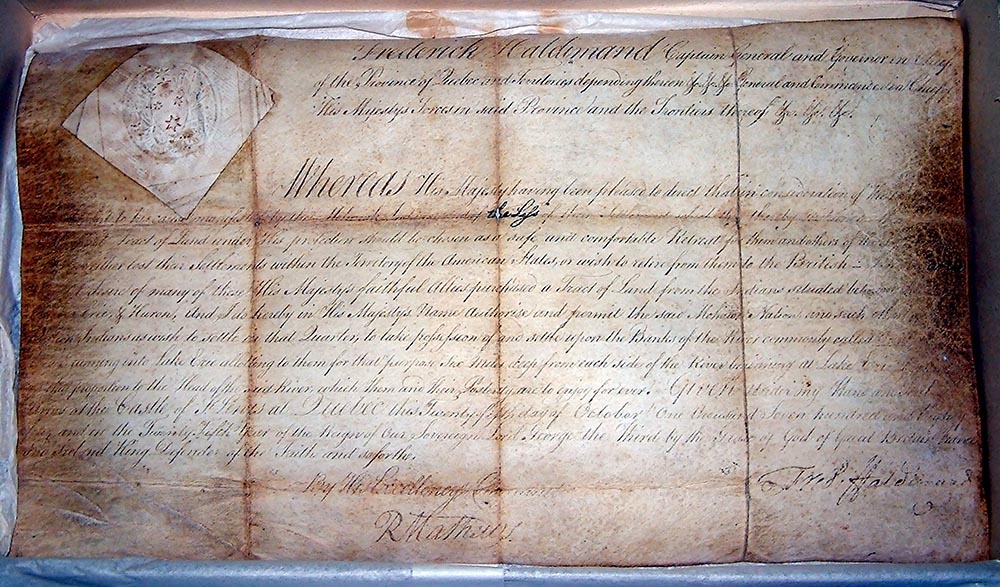
Continuity of the Crown is the doctrine that the Crown never dies. Individual monarchs come and go, but the Crown as an institution persists. This is why courts speak of the “Crown in right of Canada” as a single legal person spanning centuries: the Crown that received Mohawk allegiance and issued the Haldimand grant is the same Crown that exists today, in law.
This continuity cuts both ways. It means that old debts, old grants, and old promises are not simply wiped away when a new monarch is crowned or a new constitution is adopted. Unless they have been lawfully fulfilled, modified, or extinguished by mutual agreement, obligations like those in Haldimand remain attached to the modern Crown. Continuity makes it harder to say “that was a different time, a different government,” and easier to say “this is still our file to close properly.”
On Six Miles Deep, continuity of the Crown means that promises made by Governor Haldimand, Lord Dorchester, and John Graves Simcoe are not “expired” just because time has passed or Canada has evolved from colony to dominion to modern state. The same Crown that benefited from Mohawk alliance, Loyalist sacrifice, and the creation of a Grand River refuge is the Crown that today collects taxes, issues patents, and enforces jurisdiction on that same land.
This continuity cuts two ways. It underlines the long-standing relationship between Mohawk posterity and the Crown as an institution, and it also strips away the excuse that “those were different times.” If the Crown is continuous, so is the honour debt associated with Haldimand. Continuity of the Crown is thus a key term for explaining why the obligations are still alive, even if officials would prefer to talk about them as distant history.