
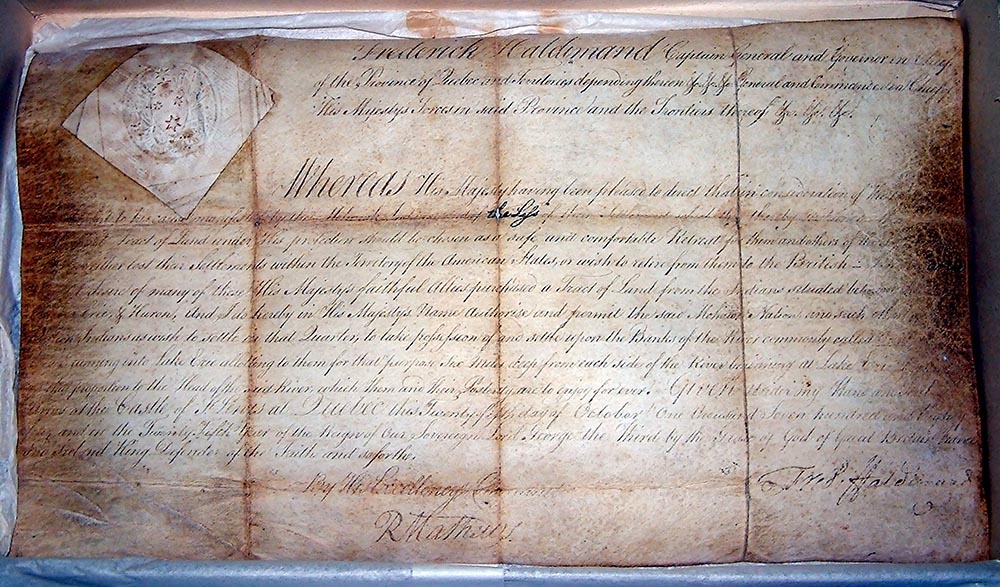
A United Empire Loyalist (U.E.) is, in Lord Dorchester’s scheme, a person who “adhered to the unity of the Empire and joined the Royal Standard in America” before 1783, and all of their children and descendants “by either sex.” Originally, U.E. was not a genealogy hobby label – it was a Crown category for people who had suffered loss, exile, and danger because they stayed loyal to the King during the American Revolution. Dorchester’s 1789 Council minute ordered that these families and their posterity be marked in parish registers, militia rolls, and other public records, and treated as “proper objects” for future benefits and privileges.
The practical expression of this is the U.E. post-nominal: the capitals “U.E.” placed after a person’s name. Dorchester’s note makes it clear that this mark was meant to travel down the line “by either sex” – an unusually generous rule for that era, when many European systems privileged only the male line. In theory, U.E. could attach to descendants through their mothers as well as their fathers, which fits more comfortably alongside matrilineal Mohawk clan law than later, stricter Indian Act ideas about identity.
Over time, genealogical societies and heritage groups picked up the U.E. mark and treated it mainly as a badge of ancestry. The United Empire Loyalists’ Association of Canada (UELAC) and similar bodies issue certificates to people who can prove descent from recognized Loyalist ancestors. That work has value, but it tends to present U.E. as a nostalgic honour from the past rather than as what it originally was: a living hereditary dignity the Crown intended to track in official records and keep in mind for real-world benefits such as land grants, fee-free deeds, and preferential treatment.
In the modern Canadian system, almost all hereditary titles have been shut down by policy and practice. Parliament no longer recommends new hereditary honours; Canada does not create local nobility. In effect, only two hereditary Crown dignities remain in the Canadian constitutional space: (1) the King/Queen, the hereditary sovereign who holds the Crown in right of Canada, and (2) the U.E. Mark of Honour flowing from Dorchester’s decision. The U.E. designation is therefore not just a family hobby; it is one of the only surviving hereditary signals the Crown itself built into this country.
On Six Miles Deep, that fact cuts deep. Along the Grand River, many Mohawk families are both Haudenosaunee by clan law and Loyalist by descent. They stand at the intersection of the only two hereditary Crown lines Canada still carries: the royal house itself, and the U.E. mark that was supposed to follow Loyalist posterity “by either sex.” When those same families are treated today as ordinary taxpayers on “ordinary Ontario land,” with no recognition of U.E. status or Haldimand promises, it shows how far Canada has drifted from its own honour system.
Legally, the U.E. category also exposes a gap between heritage practice and constitutional obligation. If the Crown once meant U.E. to be recorded in militia rolls, parish books, and land boards as a way of flagging a class of people who were owed special consideration, then turning it into a purely symbolic club badge is a form of quiet erasure. For Mohawk Loyalist posterity on the Grand River, restoring U.E. to its original weight – as a Crown-created hereditary dignity linked to land, loss, and promised benefits – is part of rebuilding a credible framework for standing, remedies, and jurisdiction on Six Miles Deep.