
|
Getting your Trinity Audio player ready…
|
What follows is a formal address from the posterity of the Mohawk Loyalists to His Majesty King Charles III. It is written not as a plea for recognition within Canada’s ordinary domestic framework, but as a reminder to the Crown of obligations long pledged and never extinguished. It sets out, in direct terms, what Mohawk Loyalist Posterity would say to the King if received in proper audience today.
TO HIS MAJESTY THE KING
To Charles III,
By the Grace of God of the United Kingdom, Canada and His other Realms and Territories King, Head of the Commonwealth, Defender of the Faith:
May it please Your Majesty,
We, the living posterity of the Mohawk Nation—who fought as loyal allies with Your Royal Ancestors in defence of the British Crown—address Your Majesty directly as covenant partners. We do so not as subjects petitioning within Canada’s domestic administration, but to remind the undivided Crown of its solemn and unextinguished word.
The relationship between our people and the British Crown is ancient and honourable. Our ancestors maintained this alliance through formal agreements sealed across generations. We are the descendants of the Four Mohawk Kings who travelled to Britain in 1710 to meet Queen Anne, and of Thayendanegea (Joseph Brant), who addressed King George III’s court as an equal. This alliance was formed and tested during the American Revolutionary War. Many of our people remained loyal to the Crown and suffered major losses as a result. Our ancestors gave not merely their military service but their homes, their villages, and their way of life in testimony to that loyalty.
In 1779, Governor Frederick Haldimand issued a solemn pledge specifically to “some of the Mohawks” from the villages of Canajoharie, Tikondarago (Fort Hunter), and Aughugo (Oquaga). Because of their loyalty to the King, their settlements had been destroyed by the rebels. Haldimand assured that those villages would be restored or that equivalent land would be provided at government expense. This pledge identified a specific group: the loyal Mohawk warriors and their families from those three villages. Their service had cost them their homes, and the Crown promised to make it right.
We, the living posterity of the Mohawk Nation, are the direct descendants of these named “some of the Mohawks. ” The Mohawk loyalist posterity are precisely the living heirs of this specially identified group from Canajoharie, Tikondarago, and Aughugo. The addition of “such others” of the Six Nations who later settled on that quarter does not cloud or dilute the original pledge made to this distinct body of loyalists.
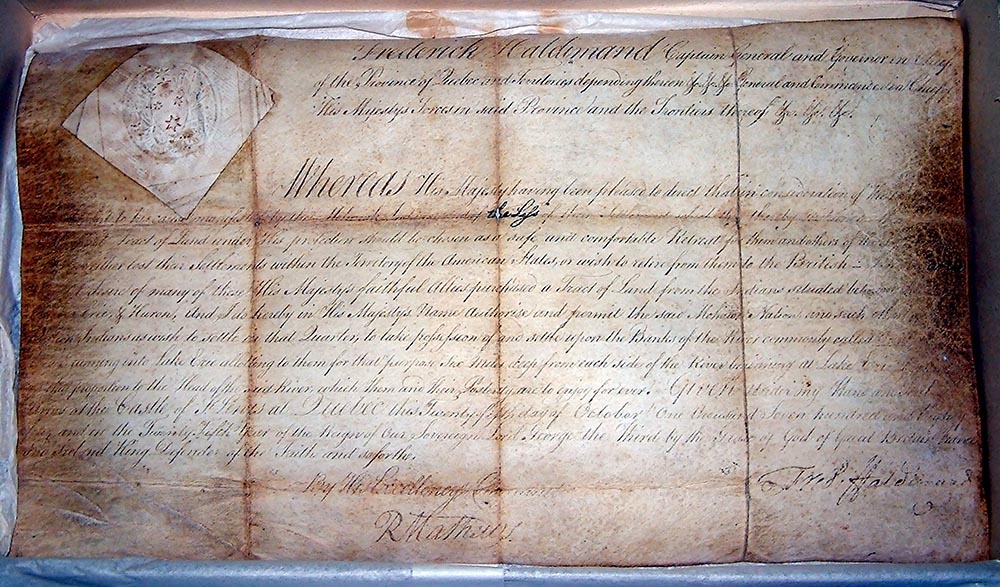
This 1779 pledge was fulfilled and expanded in the Haldimand Proclamation of 1784, issued by the same Governor in the name of Your forebear King George III. The Proclamation states clearly:
“Whereas His Majesty having been pleased to direct that in consideration of the early attachment to his cause manifested by the Mohawk Indians… to settle in that quarter to take possession of and settle upon the Banks of the… Grand River… allotting to them for that purpose six miles deep from each side of the river beginning at Lake Erie and extending in that proportion to the head of the said river, which them and their posterity are to enjoy for ever.”
This granted the Grand River tract to the loyal Mohawks and their posterity as acquired territory. The word forever was not rhetorical flourish — it was the deliberate language of a sovereign Crown binding itself and its successors in perpetuity.
In 1791, the British North American government confirmed the Haldimand Proclamation to uphold the honour of the Crown, where its faith was pledged to the Mohawks of the Grand River. This confirmation bound the Crown’s obligations to the specific loyalist posterity. Section 109 of the Constitution Act, 1867 states that all Lands, Mines, Minerals, and Royalties belonging to the several Provinces at the Union “shall belong to the several Provinces… subject to any Trusts existing in respect thereof, and to any Interest other than that of the Province in the same. ” The Haldimand lands, set apart by imperial Crown pledge and confirmed in 1791, carry such a trust and interest in favour of the Mohawk loyalist posterity. Canada and the provinces remain constitutionally bound by these pre-existing conditions. They cannot unilaterally extinguish or override what the Crown pledged before Confederation.
Our ancestors explicitly rejected the 1793 Simcoe Patent—sometimes referred to as Treaty Number 4—a domestic colonial instrument that sought to reinterpret the Haldimand lands as territory held merely “under our protection” and subject to provincial oversight. Joseph Brant and the Grand River chiefs refused to allow it to alter our relationship from one of attachment to the Crown as loyal allies to one of subordination as wards or ordinary subjects. We stand by that rejection today. Because the Haldimand pledge and Proclamation address this special and specific named people—the Mohawk loyalist posterity from the villages of Canajoharie, Tikondarago, and Aughugo—the general application of the Indian Act is defective when applied to these lands. The territory was acquired for the exclusive use and enjoyment of the Mohawk loyalist posterity. This status also prevents the unilateral imposition of provincial legislation within the six-mile tract.
Your late mother, Her Majesty Queen Elizabeth II, affirmed this relationship on two notable occasions. In 1984—exactly two years after the Canadian Charter of Rights and Freedoms came into force—during the bicentennial of the Haldimand Proclamation, she visited Her Majesty’s Royal Chapel of the Mohawks and presented royal gifts, including signing the historic Queen Anne Bible. Then, in 2010, she commemorated the 300-year anniversary of the royal family relationship with the Mohawks—marking the 1710 visit of the Four Mohawk Kings to Queen Anne—by personally presenting two peals of silver hand bells to the Chapels Royal of the Mohawks. Engraved with the words “The Silver Chain of Friendship 1710-2010,” these bells served as a tangible reminder of the long-standing alliance. Our relationship with the Crown long predates the Canadian Charter and Constitution Act, 1982, and stands apart from them. It is a pre-Confederation, pre-Charter covenant rooted in alliance, loyalty, and the Crown’s pledged faith. These royal acts were not ceremonial courtesies. They were acknowledgements by the reigning Sovereign of a living and continuing relationship — and we receive them as such.
We make known to Your Majesty that, in the generations since Confederation, the direct diplomatic channel between our nations and Your Majesty’s person has been quietly severed. What was once a relationship of Crown-to-Nation has been funnelled through subordinate ministers, bureaucrats, and “consultation” processes that treat us as one more domestic interest group within the Crown-in-right-of-Canada. The Governor General, Lieutenant Governors, and federal departments now speak “on behalf” of the Crown, but they do not carry the personal honour of the monarch that our ancestors understood.
Meanwhile, federal, provincial, municipal, corporate, and private actors have imposed controls, alienations, encumbrances, and conflicting claims upon the Grand River tract. These acts—carried out in the name of the Crown—are inconsistent with the pledge of 1779, the Proclamation of 1784, the 1791 confirmation, and the trust preserved under section 109 of the Constitution Act, 1867. They undermine the honour of the Crown, which requires that solemn undertakings be performed in substance and not merely acknowledged in form.
We do not come to You seeking new treaties or numbered agreements that would reduce us to wards of the state. We come to remind You that the Haldimand lands remain ours by Your Royal word. Our jurisdiction upon them, our right to govern ourselves according to our own Great Law of Peace, and our direct relationship with the monarch are not extinguished by Canadian statutes or court rulings. They pre-date Confederation and sit outside its ordinary federal-provincial framework.
We therefore ask that the 1779 pledge, the 1784 Proclamation, and the 1791 confirmation be acknowledged as continuing and binding obligations of the Crown to the Mohawk loyalist posterity; that the Grand River tract be recognized as land set apart for their exclusive use and enjoyment; that conflicting claims be removed or reconciled with the original terms; that laws inconsistent with those obligations be reviewed and restrained; and that a direct channel of communication be restored between the Crown and our people.
May it please Your Majesty to receive our representatives in audience, as Your Royal Predecessors received ours, so that these matters may be addressed in proper diplomatic form.
The covenant has not been broken on our side. We have preserved our identity and our law for more than two centuries.
The faith pledged to our people in 1779, affirmed in 1784, and confirmed in 1791 continues in full force, and stands as an obligation of the Crown recognized in law.
That faith now rests with the Crown in Your Majesty’s person, and the honour of the Crown remains engaged in its due performance.
We place these matters before Your Majesty in the confident expectation that the honour of the Crown will be upheld.
All of which is respectfully submitted.
We remain,
Your Majesty’s loyal allies and covenant partners,
The Posterity of the Mohawk Loyalists
Mohawk Nation of Grand River – Secretariat
Leave a Reply