
|
Getting your Trinity Audio player ready…
|
What would it mean if Mohawk jurisdiction were treated as real?
Not a slogan. Not a symbolic aspiration. Not something to be deferred behind consultation tables, municipal process, or provincial convenience. What would it mean if the underlying rights of the Mohawk Nation of Grand River and its Loyalist posterity were actually observed according to their original constitutional character?
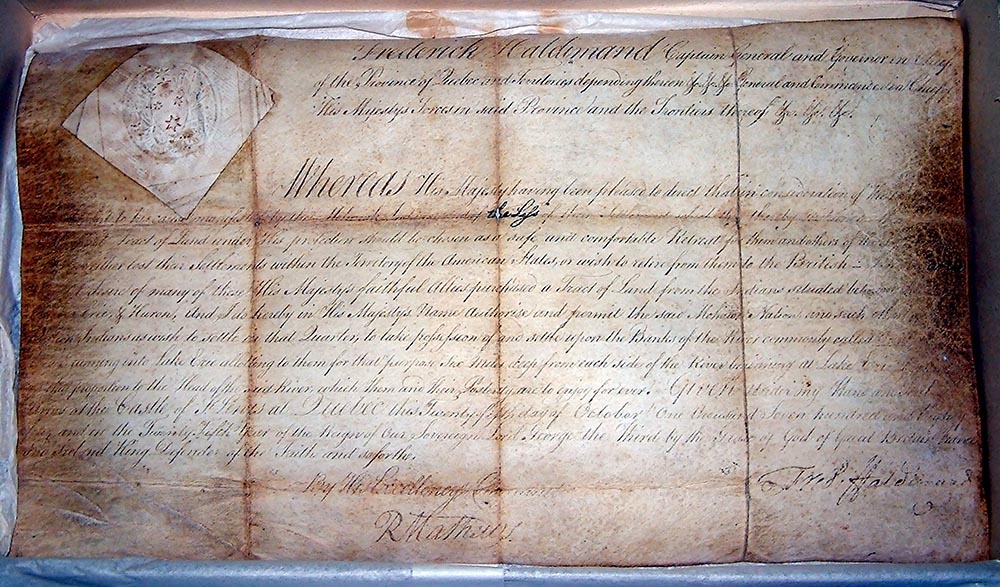
The answer begins with a point most governments, lenders, developers, and local authorities have avoided for generations. The Haldimand Proclamation is not a historic gift, not a revocable Crown favour, and not a reserve arrangement dressed in older language. A constitutional confirmation of an acquired territorial settlement, set apart for the exclusive use and enjoyment of a defined people and their posterity forever. That interest was never lawfully surrendered, never extinguished, and never denounced—only obscured by later provincial routines that assumed authority without resolving it.
That means the issue is not whether Mohawk jurisdiction is being invented. It already exists. The issue is whether a pre-existing jurisdiction and territorial interest—will finally be acknowledged and allowed to operate as law.
Once that is understood, everything else begins to change.
Land is no longer treated as a commodity circulating through Ontario’s title system. It is first understood as territory burdened by a prior and senior underlying interest. Occupation may continue. Commerce may continue. Homes may stand. Businesses may operate. But all of it exists subject to a constitutional condition that never disappeared—only wilfully ignored.
For years, the system has managed Mohawk interests as a background inconvenience: disclosed, litigated, or politically delayed. But a latent defect remains a defect. A burden does not vanish because it is concealed behind paperwork and confidence.
This is already becoming visible elsewhere. In British Columbia, unresolved Indigenous title and underlying interests have begun producing direct consequences in the mortgage market. Lenders have shown hesitation. Renewals have become uncertain in some situations. The lesson is obvious. Where the legal foundation beneath land use is unstable or unresolved, markets eventually react. They simply postpone the reckoning until risk becomes impossible to face.
The same problem exists along the Grand River. The difference is only that Ontario has been more comfortable normalizing the contradiction.
A real Mohawk jurisdictional framework would end that evasion. It would place the underlying interest in its proper position at the front of the analysis rather than buried in the fine print. That would not create uncertainty. It would expose the uncertainty that already exists and replace it with a system of order grounded in the actual condition of the land.
That has immediate implications for development. It means projects can no longer proceed on the assumption that municipal approval and provincial paperwork are sufficient. They are not, where they rest on defective jurisdictional foundations. Consent is no longer a procedural afterthought once decisions are made. It becomes a condition precedent.
Projects inconsistent with the exclusive use and enjoyment of the territory are subject to refusal, correction, suspension, removal, or legal challenge. Projects aligned with Mohawk priorities and territorial obligations proceed with clarity, because the underlying burden is addressed at the outset—not deferred.
Housing would change just as dramatically.
Under the current Ontario model, housing is treated largely as a market instrument. That model produces predictable results: speculation, rising costs, unstable tenure for the vulnerable, and ultimately dispossession dressed up as neutral administration.
A Mohawk system begins there.
If the land is set apart for the exclusive use and enjoyment of the Mohawk Nation of Grand River and its posterity, then housing is not merely a private transaction. It is part of the territorial purpose itself. Conditions that permit abrupt displacement, speculative clearing, or restructuring for outside gain are no longer treated as normal. The governing principle becomes the right to remain, to grow, to house posterity, to adopt, and to sustain intergenerational continuity. Housing policy is ordered toward permanence, stewardship, and growth without surrender.
That growth matters. Mohawks are not static. They assert the space to expand, to build, to house families, and to establish institutions that convert territorial rights into lived stability. The false divide between development and jurisdiction collapses. Growth continues—but under the authority of those whose underlying interest gives the territory its lawful character.
Transportation makes the same point in motion.
The Mohawk National Vehicle Registry matters because it is not theoretical. It is a practical expression of regulatory authority tied to territory. Movement on Mohawk land is not simply a provincial privilege assumed by Ontario as if no other authority exists. Vehicles, drivers, insurance, and regulatory standards can be organized within a jurisdiction and governance that arises from the land itself.
The same applies to insurance. Entry into a territory carries conditions. One does not assume a right to use corridors, conduct commerce, move goods, and generate profit through a burdened territory while ignoring the authority that holds the underlying interest. A Mohawk system can require recognized insurance, levies, tolling, registration, and compliance as conditions of lawful participation.
This is not novel. It is how functioning jurisdictions operate. The difference here is that the authority does not originate from a late provincial statute, but from a prior territorial right those statutes were always obliged to respect.
Once that is accepted, the broader regulatory picture becomes unavoidable.
Exclusive use carries with it the right of regulation. An underlying interest carries with it the authority to control what enters, what burdens, what operates, and what has legal effect within the territory. That includes goods, services, infrastructure, commercial operations, logistics, and financial arrangements. It also includes intangible forms of entry that colonial systems often treat as beyond territorial control.
Trademarks, patents, intellectual property, commercial identity, and cultural use do not exist in the abstract. They derive force from the jurisdiction that recognizes and enforces them. They are not rights floating above the land. They are applied through authority.
A real Mohawk jurisdiction therefore includes the power to regulate commercial branding and protected use within the territory, to challenge infringement, to protect Mohawk names, symbols, language, institutions, and commercial identities from misuse, and to determine which legal and economic instruments will be recognized as valid within Mohawk land. If external systems enforce these rights for their own benefit, there is no principled basis to deny Mohawk jurisdiction the same authority—especially where it rests on a prior and unsurrendered territorial right.
This is where the argument becomes uncomfortable for those who have grown used to ignoring Mohawk interests. Because once exclusive use is taken seriously, the corollary powers follow.
There is a right to regulate the flow; to inspect, screen, condition, and monitor entry; to require permits, authorizations, and compliance for commercial operation; to withhold recognition from instruments or actors that purport to exercise authority without lawful basis; to remove unauthorized presences and suspend non-compliant operations; to seize, where seizure is the lawful consequence of unauthorized entry, unlawful commercial activity, or non-compliant use within the territory; to police the flow of goods, infrastructure, and high-volume corridor use where those things depend on the land and burden the land.
None of this is extraordinary in legal structure. Customs authorities seize. Regulators suspend. Police remove. Courts invalidate. Licensing bodies revoke. The real issue is not whether such powers exist in principle. The issue is whether Mohawk territorial rights are finally going to be treated as capable of sustaining the same kinds of real regulatory consequences that every other jurisdiction assumes for itself.
The answer, if the underlying interest is taken seriously, must be yes.
That is why accountability is so important. A real jurisdiction is not merely a body of aspirations. It is a structure capable of correction.
Officials occupying, administering, licensing, taxing, policing, or otherwise acting within the territory would have to answer a basic question: “by what lawful authority are you doing so in a tract burdened by an unsurrendered Mohawk interest of exclusive use and enjoyment?” If they cannot answer that question coherently, then their authority is defective. And if their authority is defective, then Mohawk jurisdiction includes the right to challenge it, correct it, refuse recognition to it, and where necessary seek the proper removal of its operative effect within the territory.
That does not mean disorder. It means law applied honestly.
Removal here must be understood properly. It is first a removal of recognized authority, not a theatrical gesture. A permit issued without lawful jurisdiction may be treated as void or inoperative. An office-holder acting outside lawful scope may be treated as lacking recognized authority within the territory. A levy, tax, order, or enforcement act incompatible with the underlying territorial interest may be challenged, rejected, suspended, or displaced by superior right. If the conflict persists, legal remedies become available to test the office, the act, and the claimed jurisdiction itself.
This is exactly where earlier common law tools become relevant. Mandamus. Quo warranto. Review of jurisdictional competence. Testing whether the actor is lawfully in office for the act they claim to exercise. These are not fringe devices. They are part of the machinery by which systems correct usurpation, excess, and unlawful assumption of power.
A complete Mohawk jurisdiction is necessary to build Mohawk institutions.
Mohawk police would be central. Not as an auxiliary or decorative force, but as a primary peace and regulatory authority within the territory, charged with maintaining order according to Mohawk law, Mohawk priorities, and the territorial framework grounded in exclusive use and enjoyment. Their role would include public safety, regulatory enforcement, corridor oversight, protection of persons and property, enforcement of lawful seizures and removals, and cooperation with other services only within terms consistent with Mohawk authority. That is what real policing means: not borrowed symbolism, but operative jurisdiction.
Mohawk radio and communications systems would be just as essential. A nationalized radio network would not merely be media. It would be public infrastructure. It would carry emergency notices, regulatory directives, territorial announcements, cultural content, language revitalization, and direct communication from governing institutions to the people. Removing dependence on outside filters for the basic circulation of public authority.
Mohawk banking and trust structures would anchor the economic side of jurisdiction. Wealth generated from the land should not continue to drain automatically outward into systems that neither recognize nor serve the territorial right that makes the land valuable in the first place. A Mohawk banking structure, whether trust-based or institutionally expanded, would allow capital, levies, tolls, licensing revenue, and commercial contributions to be retained, managed, and reinvested within the territory. That means housing finance aligned to community need. Infrastructure lending aligned to territorial planning. Community investment aligned to posterity rather than extraction.
This is how wealth generation becomes real for Mohawk families.
Under the current model, many families live inside a contradiction. Their territory produces immense value, yet they often experience the territory as insecurity: rising prices, uncertain access, administrative hostility, external licensing, external banking, external policing, external titles, external courts, external definitions of who matters. Their presence is treated as historic while the wealth of the land is treated as contemporary and available.
A real Mohawk jurisdiction reverses that pattern.
For Mohawk families, daily life becomes stability grounded in belonging. Housing is built around continuity. Growth is structured around posterity. Vehicles, insurance, permits, and business activity are governed through Mohawk institutions, not tolerated at the margins of Ontario systems. Education and employment expand because functioning institutions require administrators, police, planners, lenders, coders, communicators, builders, regulators, and legal thinkers. Children grow up within a system that assumes their future on the land—rather than forcing them to negotiate for it.
And technology would make that system usable.
That point matters. Without technology, opponents will pretend that Mohawk governance is cumbersome, impractical, or nostalgic. With technology, the opposite becomes obvious.
Apps for public administration could handle permits, registrations, levy payments, insurance validation, business licensing, and territorial notices. Security systems could verify identity, entry conditions, and compliance in real time. Mapping tools could show the corridor, the applicable boundaries, the riparian implications, and the jurisdictional status of locations instantly. Government services could be delivered through platforms designed for transparency and public access. Businesses could interact with regulators quickly. Police could verify authorizations immediately. Residents could know their rights and obligations without guesswork.
Technology will not replace law. It will make law visible.
It would also make the system harder to ignore. Once the jurisdiction is mapped, digitized, communicated, regulated, and institutionally administered, outsiders can no longer pretend the issue is vague. The framework would be functioning in front of them.
For non-Mohawk residents, investors, and businesses, the consequences may be serious but not inherently hostile. The present system already contains risk. It simply hides it. There are already underlying interests. There are already title concerns. There are already unanswered questions about jurisdiction, disclosure, consent, and legal exposure. The market is not protected by denial. It is anesthetized by it.
A real Mohawk framework would force honesty at the front end. Those investing, building, lending, transporting, marketing, or operating within the territory would have to recognize the jurisdiction they are entering. They would need valid authorizations. They would need recognized insurance. They would need compliance with Mohawk regulation. They would need to respect intellectual property, names, symbols, and protected territorial conditions. If they did so, they would gain something rare in the current system: clarity. If they refused, then they would do so knowingly, in the face of a functioning jurisdictional record, and they would face the corresponding legal and regulatory consequences.
Not instability. Order with standards.
The real instability is the one Ontario and Canada have normalized: a territory with a prior unsurrendered interest being managed as though the burden were merely political noise; a people with exclusive rights being treated as stakeholders among others; a legal contradiction allowed to deepen until lenders hesitate, evictions occur, infrastructure advances, and institutions act beyond competence because no one stopped them early enough.
The more Mohawk rights are operationalized, the more obvious it becomes that the old model depends on ongoing disregard. It depends on everyone acting as though silence can extinguish, administration can replace dedication, and convenience can outrank constitutional honour. It cannot.
If the territory was acquired, confirmed, and set apart for the exclusive use and enjoyment of the Mohawk Nation of Grand River and its posterity, then the rights flowing from that condition are not minor. They are structural. They include the right to regulate, the right to condition entry, the right to govern commerce, the right to protect intellectual property and identity, the right to levy and toll, the right to police the flow, the right to seize where lawful, the right to remove where unauthorized, the right to build institutions, the right to grow, and the right to convert underlying territorial interest into lived, enforceable reality but most importantly the right to exist.
Leave a Reply